Gemini 4 Carbon and Argon Prices Double on December 1: What It Actually Costs Your Agent Workloads
Google doubles Gemini 4 Carbon and Argon rates on Dec 1, 2026. Worked cost math for agent workloads, hidden tiers, and the one model untouched.
By Bongyeon Kim · Researched from primary sources, verified by hand, and produced with AI assistance on a production stack this site actually operates (Vercel · Neon · Cloudflare R2).
TL;DR
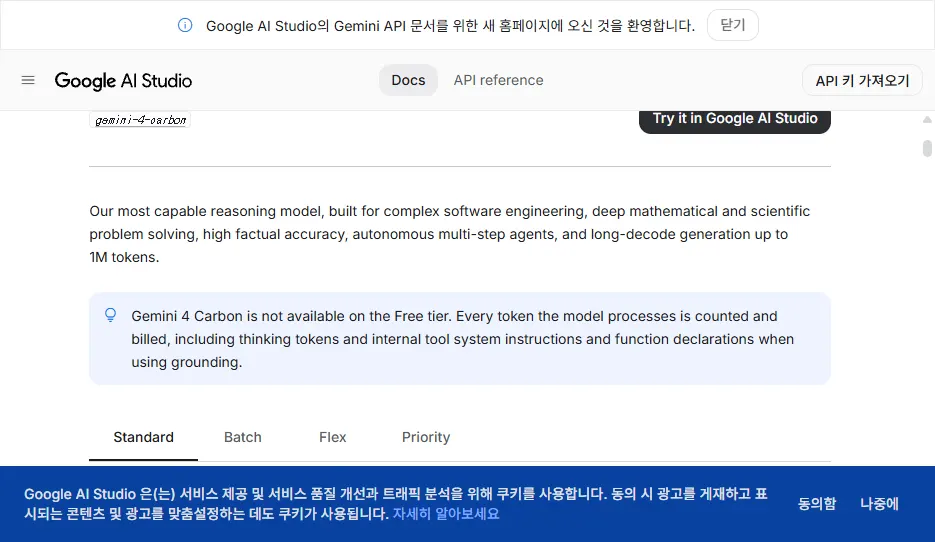
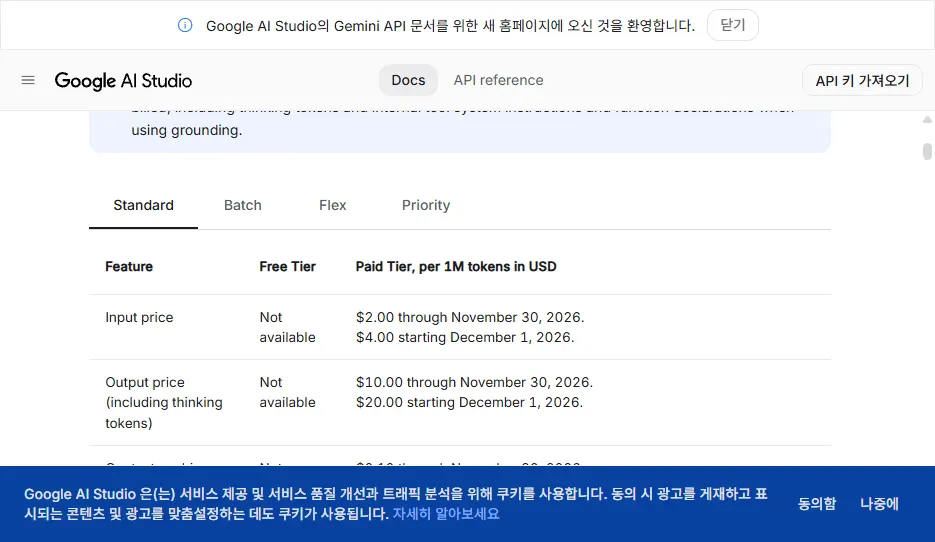
Google's introductory pricing on Gemini 4 Carbon and Gemini 4 Argon expires November 30, 2026. From December 1, both models bill at $4.00 per 1M input tokens and $20.00 per 1M output — exactly double the current $2.00/$10.00. Cached input doubles from $0.10 to $0.20. Gemini 4 Hydrogen is untouched at $1.50/$7.50. If your agent workload bills mostly in thinking tokens (which bill as output), your December bill doubles with no code change — unless you switch models or use Batch/Flex. The tables below are pulled from Google's official pricing pages on 2026-11-23; anything not stated there is marked as unknown.
What actually changes on December 1
Google published the dates on the pricing page itself, which is rarer than it should be:
| Model | Input (per 1M) | Output incl. thinking (per 1M) | Cached input |
|---|---|---|---|
| Gemini 4 Carbon | $2.00 → $4.00 | $10.00 → $20.00 | $0.10 → $0.20 |
| Gemini 4 Argon | $2.00 → $4.00 | $10.00 → $20.00 | $0.10 → $0.20 |
| Gemini 4 Hydrogen | $1.50 (no change) | $7.50 (no change) | $0.075 (no change) |
Three details that trip people up:
- Regional endpoints cost 10% more. Google Cloud's Agent Platform lists "non-global" rates — Carbon/Argon go $2.20 → $4.40 input, $11.00 → $22.00 output on December 1. If you pinned a regional endpoint for data residency, your increase is 100%, not 95%.
- Cache write pricing arrives January 12, 2027. Right now implicit caching is a pure discount ($0.075 cached reads on Hydrogen). From January 12, cache writes bill separately (e.g., $1.875 per 1M on Hydrogen). Budgets modeled in December will shift again in January.
- The promotional structure is explicit. Google Cloud's table footnote says the introductory rates come "through 50% credits back on net spend on select models." This is not a price increase in the abstract — a discount is ending.
Who pays double in practice
Token-in/token-out math underestimates agent workloads, because thinking tokens bill as output — and on Carbon and Argon, output is the rate that doubles from $10 to $20. A multi-step agent that burns 60% of its tokens in reasoning gets hit harder than the 2× input headline suggests.
Worked example (numbers are illustrative, the rates are Google's):
| Monthly workload | November bill | December bill |
|---|---|---|
| 200M input + 60M output (chat, thin reasoning) | $400 + $600 = $1,000 | $800 + $1,200 = $2,000 |
| 50M input + 80M output (agentic coding, heavy reasoning) | $100 + $800 = $900 | $200 + $1,600 = $1,800 |
| Same agentic workload, 80% cached input | $10 + $800 = $810 | $20 + $1,600 = $1,620 |
The cached-input row is the trap: caching discounts the doubled rate, it doesn't exempt you from it. Google's cache condition lines also only say "implicit caching only" — explicit caching is not supported on any Gemini 4 model, so you can't pin long-lived caches to soften the output-side doubling.
The tiers nobody reads (until the invoice arrives)
Google Cloud's Agent Platform table splits every model into Standard / Batch / Flex / Priority, and the differences are large enough to change your December decision:
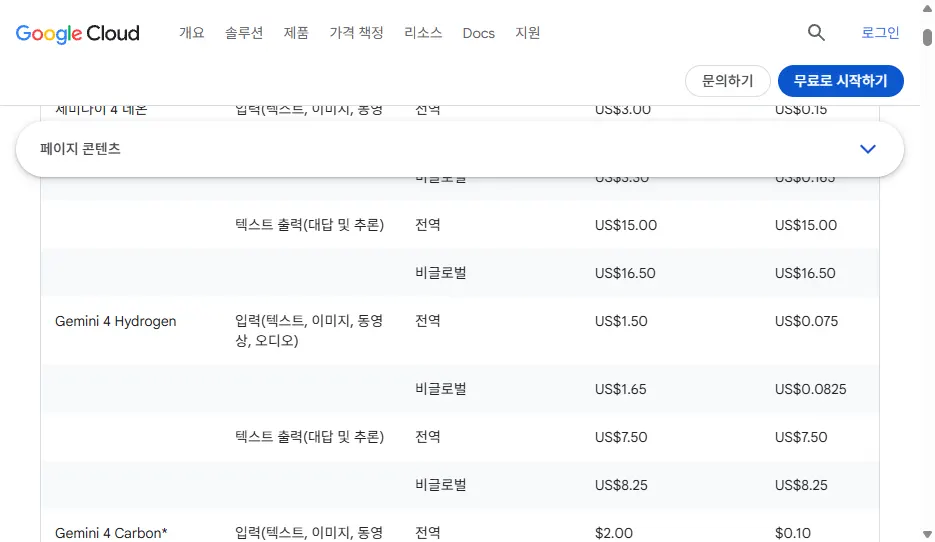
- Batch / Flex (Hydrogen listed at $0.75 input / $3.75 output) is roughly half of standard. If your workload tolerates latency, moving agentic batches to Batch absorbs a good chunk of the Carbon/Argon doubling.
- Priority costs more than standard (Hydrogen: $2.70 / $13.50) — the anti-tier for cost cutting, relevant only if you need guaranteed throughput.
- Grounding with Google Search is billed per query: 5,000 free requests per month shared across Gemini 3+ models, then $14 per 1,000 (daily cap 1,500). Agents that search on every step can generate a grounding bill that looks like a model bill.
[unverified] The page does not state whether Hydrogen's $1.50/$7.50 is itself promotional. A third-party analysis noted the same gap: no end date is published for Hydrogen pricing. Treat Hydrogen rates as stable-until-announced, not stable.
The one model untouched — and the migration math
Hydrogen keeps $1.50 input / $7.50 output across its full 1M context, with a 95% implicit-cache discount. It scored above Argon on Artificial Analysis' index at high thinking settings in Google's own announcement. The question for December is not "is Hydrogen as smart as Carbon" — it isn't — but whether your workload's value density needs Carbon.
The break-even is simple to compute: if Carbon costs 2× Hydrogen per task and your task-completion rate on Hydrogen is above ~50% of Carbon's, Hydrogen is cheaper per completed task. Track completions, not tokens, for the next two weeks — that's the only number that survives the price change.
Which model for which reader
The December reset changes the recommendation per user group, because Argon's price advantage quietly evaporates on December 1 — Carbon and Argon both land at $4.00/$20.00, so the "efficient frontier model at a lower rate" argument stops applying:
| Your group | Recommendation | Why |
|---|---|---|
| Free-tier learners and tinkerers | Hydrogen | The only Gemini 4 model on the free tier; paid tier optional |
| Everyday coding and volume agentic runs | Hydrogen (Batch/Flex if latency-tolerant) | Flat $1.50/$7.50 across 1M context; Batch at $0.75/$3.75 absorbs the reset entirely |
| Deep engineering, long-decode, hardest problems | Carbon — if output is worth $20/1M | Dec 1 doubles its bill; only pay it where reasoning quality is the product |
| Argon users | Re-decide | Post-reset it costs the same as Carbon — switch to Carbon for capability or Hydrogen for cost; keep Argon only if its response latency matters to you |
| Budget-capped teams | Hydrogen + implicit caching | 95% cache discount on the only model with no announced increase |
One honest caveat: this table is our read of Google's published rates, not a benchmark study. Model quality shifts week to week; re-check completions-per-dollar on your own workload before committing a production budget.
What we would do before December 1
- Label every environment by model. Anything pinned to
gemini-4-carbonorgemini-4-argondoubles silently. A two-line grep now beats a surprise invoice. - Move latency-tolerant jobs to Batch/Flex. The ~50% discount offsets most of the doubling.
- Re-baseline your December budget at 2× output. Then decide per workload whether to stay, shift to Hydrogen, or accept the cost.
- Watch January 12. Cache-write billing starts then; anyone relying on implicit caching should re-run the math in January.
Data and follow-ups
Rates verified against Google AI Studio's pricing docs and Google Cloud's Model Garden table on 2026-11-23. Cross-checked against Google's official Hydrogen announcement and release notes. Our November 12 scoreboard piece has the launch-day rates this article supersedes; we'll publish a follow-up once final PIR-style pricing behavior (actual billed rates on December 1) is observable.