What 24 Hours of Exchange Downtime Actually Owes You: The Microsoft 365 SLA Math, Worked
The Nov 12-13 Microsoft 365 outage: worked SLA credit math, who qualifies, what evidence to keep, and the December 31 claim deadline.
By Bongyeon Kim · Researched from primary sources, verified by hand, and produced with AI assistance on a production stack this site actually operates (Vercel · Neon · Cloudflare R2).
TL;DR
Microsoft's November 12–13 outage (~24 hours of degraded Exchange Online, Teams, and Copilot for much of the world) is now explained in a preliminary incident report: a latent July bug in Microsoft's cloud gateway, traffic shifted onto it during maintenance, and 14% less fleet capacity than intended. The money question is more useful to operators than the root cause: what does Microsoft actually owe you? For most tenants: nothing. For affected Exchange Online business tenants: a service credit of 25%–50% of that one service's monthly fee — claims due by December 31, 2026. No cash, no productivity-loss compensation. Here's the exact math.
What broke, in three sentences
A bug deployed in July caused resource exhaustion on Microsoft 365's gateway servers under certain conditions, hidden until a routine traffic shift (Teams moved from the backup gateway to the primary) exposed it. Restart attempts re-triggered the same lockouts, rollbacks couldn't undo an undiscovered bug, and over 80% of affected gateway servers froze; Microsoft needed a targeted code fix rather than failover. Incident IDs: EX1550543 / MO1550821. Microsoft says it was not a cyberattack or AI-agent issue; the final report was expected November 20.
The SLA math, worked
Microsoft's Online Services SLA measures Exchange Online uptime per tenant, per calendar month, in user minutes: total minutes in the month × number of users, minus each user's minutes of OWA mail-send/receive inability. November has 43,200 minutes.
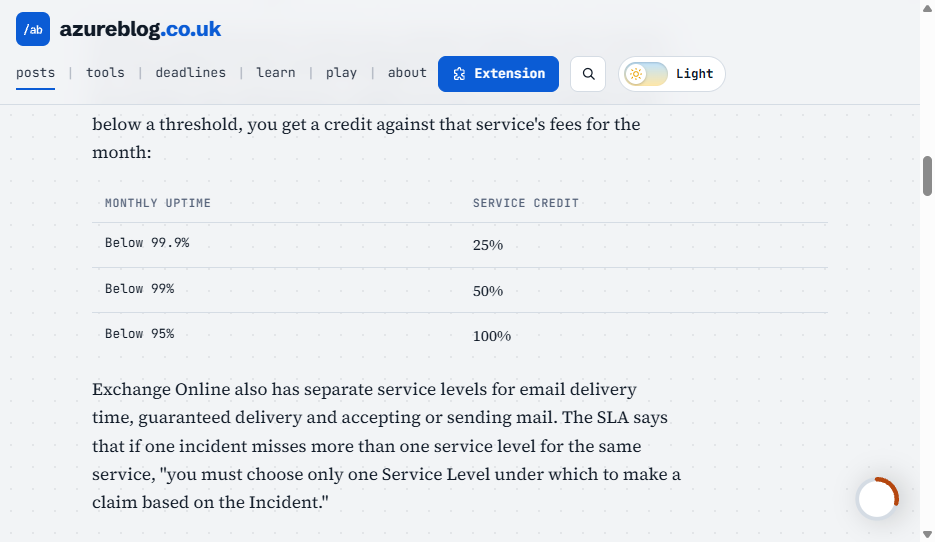
| Monthly uptime | Credit |
|---|---|
| Below 99.9% | 25% |
| Below 99% | 50% |
| Below 95% | 100% |
Worked examples (formulas from the SLA, scenarios illustrative):
| Tenant scenario | Uptime math | Credit |
|---|---|---|
| 400 users, all lost OWA for 22h | 400×43,200 − 400×1,320 min → 96.9% | 50% of Exchange Online fees |
| Half the users affected, 22h | 98.5% | 50% |
| All users affected, 6h only | 99.2% | 25% |
| 30h+ total outage (this month didn't reach it) | < 95.8% | 100% tier needs >36h |
The one calculation everyone should run: to stay above 99.9%, each user can lose only ~43 minutes all month. This outage alone was ~24 hours for many tenants. If your tenant had OWA down for most of a day, you're in the 50% tier with headroom.
Who gets a credit — and who doesn't
- Business/enterprise Exchange Online tenants: yes, likely — this is the service the outage hit hardest, and the SLA's "unable to send or receive email with Outlook Web Access" definition maps directly to what happened.
- Consumer plans: no. They don't carry the SLA.
- Teams, OneDrive, SharePoint, Copilot: often no. The outage definition is service-specific; a degraded Teams experience may never meet its own threshold, and the SLA says you must choose one service level per incident — no stacking claims.
- Azure: not part of this incident. Azure's status page showed no active events and no PIR for November; the failure was inside Microsoft's SaaS platform. Don't file Azure claims against this event.
- "Lost productivity": explicitly not compensable. The SLA calls credits "your sole and exclusive remedy," and outages "occasional interruptions" under consumer terms.
Two footnotes that matter: an incident on the status dashboard is not approval — Microsoft decides eligibility after you claim — and credits cover only the affected service's fee for the month, never the whole suite.
Filing before December 31
Evidence to gather now (Service Health keeps only 30 days of history):
- Export the incident status text for EX1550543 / MO1550821.
- Run message trace for the outage window; export results.
- Keep service-desk tickets and internal user communications with timestamps.
- Download the post-incident report from the admin center when published.
- Note your tenant ID, affected user counts, regions, and durations.
How you file depends on the purchase path: direct customers submit via Microsoft 365 admin center → Help & support (claims processed within ~45 days); CSP partners must file — customers send their partner a credit-request email from a tenant-domain address; Open/Open Value licenses receive extra service days instead of fee credits.
Reality check from analysts quoted across coverage: the credit will be small next to what a day without email costs — 50% of one service's fee for one month. File it anyway. The math is the point: knowing your SLA's definition of downtime, its user-minute arithmetic, and its claim deadline is infrastructure work you only get to practice once a year.
Is this adequate? What operators actually think
The community verdict on this compensation is roughly uniform, and it's worth stating plainly because Microsoft's SLA is drafted to make it sound generous:
- r/microsoft and r/sysadmin threads during the outage (the "10+ hours and counting, only marginal recovery" and apology megathreads) trended toward resigned anger — the recurring line is that a fee credit for the affected service only doesn't come close to a day of lost email for a business, and that "sole and exclusive remedy" means Microsoft never owes more than a discount. Several admins noted the irony that the outage outlasted the workweek it interrupted.
- Press analysis (Quartz's rights-and-remedies rundown) makes the same structural point in neutral terms: the credit "goes against the service bill. It is not paid out as cash" — and lost business is outside the contract by design.
- The starkest illustration of the gap: a German hotel's pool chlorination system — tied into Microsoft 365-hosted workflows — reportedly poisoned guests during the outage. [unverified] That's a LinkedIn-circulated report, not a court finding, but it captures why sysadmins treat SLA credits as accounting, not compensation: the real protection for outage risk is redundancy (secondary mail provider, on-prem fallback), not the credit.
Our own read, as a small operator: the credit is best treated as a rebate on a bad month, not insurance. The math worth doing is the one in the table above — not to feel compensated, but to know exactly what your provider contractually promises, which is almost always less than you assumed.
References
Microsoft SLA for Online Services (October 2026 edition); Microsoft preliminary post-incident report (reproduced by Office Watch); Ars Technica PIR coverage; azureblog.co.uk claim guide; analyst commentary via ABC News. Related: our November 12 outage piece — what breaks on a small operator's stack when a vendor dies for 12 hours.