Smolmaxxing: Making Old Laptops Run Local LLMs — The E-Waste AI Play (2026)
smolmaxxing runs a 16B model on 1 GB of RAM. What your old laptop can actually run, real tokens/sec numbers, and when $0 hardware beats the cloud.
By Bongyeon Kim · Researched from primary sources, verified by hand, and produced with AI assistance on a production stack this site actually operates (Vercel · Neon · Cloudflare R2).
A Xiaomi TV box with about 1 GB of usable RAM is currently running a 16-billion-parameter language model at 5.1 tokens per second. A 2013 iPad Air with 700 MB of usable RAM is running the same class of model at up to 4.5 tok/s, and a 1.7B model at 24–26 tok/s. Both numbers are measured on the devices themselves, published with full benchmarks, and reproducible — the whole effort is open-sourced as a project called smolmaxxing, which hit Hacker News' front page this week with 361 points ("I'm making LLMs work on small and old devices").
The name is a joke; the thesis isn't. Most of the hardware in your home that has a CPU, some RAM, and flash storage — TV boxes, old tablets, old laptops, thin clients — sits idle most of the day. smolmaxxing finds the biggest model each device can really run, then pushes past what stock inference software says is possible. And it matters right now for a reason this blog keeps coming back to: new hardware is expensive (see The 2026 RAM Price Crisis: Why a $110 'Discount' Still Means $539 for 32GB DDR5), while the old stuff is functionally free.
TL;DR
- smolmaxxing (GitHub, hyperionaidev/smolmaxxing) is a patched llama.cpp plus rebuilt model files that runs 8B and 16B mixture-of-experts models on devices with ~1 GB of usable RAM — a $70 TV box and a 2013 iPad Air.
- The tricks: hand-written 1-bit/2-bit/ternary kernels for cheap ARM cores, a pruned vocabulary head (saves 0.2–0.5 GB), paging MoE experts from flash with prefetch, and streaming dense weights straight off flash at 278 MB/s.
- Real numbers from the project: 2B at 7.7 tok/s, 8B MoE at 7.2 tok/s, 16B MoE at 5.1 tok/s — all on the TV box. The iPad does 24–26 tok/s on a 1-bit 1.7B.
- The catch is patience and quality: 3–8 tok/s is readable but not agentic, and tiny models still fail at tool calling and real work unless fine-tuned or paired with a good harness.
- The Tech × Money frame: $0–100 thrift hardware as inference nodes vs. buying new in a year when RAM and GPUs cost more. It works for chat, summarization, and batch jobs; the cloud still wins for anything big, fast, or agentic.
What the project actually does
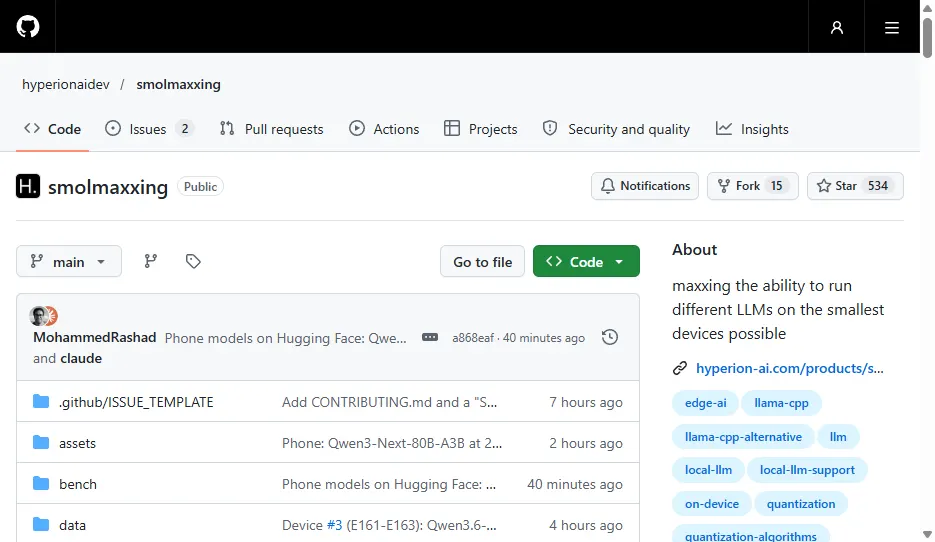
Everything in smolmaxxing is a patch on llama.cpp, plus specially rebuilt GGUF model files (stock llama.cpp can't load them — the formats are custom). The project documents two devices so far, and every number was measured on the hardware itself, with the full lab notebook — 160 experiments, failures included — in the repo.
Kernels built for the chip. The TV box's Cortex-A55 cores support ARM's dot-product instructions but not the fancier matrix ones, so stock llama.cpp leaves performance on the table. The authors repacked Q2_K weights for the vdot instruction (generation up 41% on that path), built a ternary format that stores weights in a lossless 1.875 bits apiece, and wrote a 1-bit lookup-table kernel in the Four-Russians / T-MAC style. A 1-bit 8B model (Bonsai-8B) went from 3.77 to 5.1–5.4 tok/s from this kernel work alone.
Less RAM per model. A small model's output head — one row of weights per vocabulary token — is often a huge fraction of its memory. smolmaxxing keeps only the ~49–66K most useful vocabulary rows (chosen by token frequency across English, code, and other languages) and hard-blocks the rest, saving 0.2–0.5 GB at a cost of missing about 1% of English tokens. A "headless" mode also kills the Android launcher, Google services, and the screensaver while a model runs, taking free RAM from ~1,000 MB to ~1,300 MB.
The expert pager — the trick that makes 16B-on-1GB work. Mixture-of-experts models only use a few of their "experts" per token, which means most of the weights are dead weight at any moment. The pager keeps the ~43 most popular experts per layer in RAM and reads the rest from flash on demand with parallel direct disk reads, prefetching the next layer's likely picks. A small routing bias toward experts already in RAM cuts cache misses from 13% to about 2%. This is how Ling-mini-2.0 (16B, MoE) runs on a TV box.
Streaming for dense models. For models bigger than RAM entirely, the patch streams weight blocks off flash at the drive's full 278 MB/s, prefetched ahead of the compute, freed right after use. It even adds speculative decoding: when you're flash-bound anyway, verifying 2 tokens per pass over the weights is nearly free, measured at +69% throughput.
If you've read How Much RAM You Actually Need in 2026, this flips that article's logic: instead of matching RAM to your workload, the smolmaxxing approach matches the model to the RAM you already have — and treats flash as an extension of memory.
What your device can realistically run
Project-measured numbers are marked as such; the rest are community benchmarks and standard llama.cpp expectations — treat them as rough ranges [unverified].
| Device tier | RAM / VRAM | Realistic model | Tokens/sec expectation |
|---|---|---|---|
| TV box / old tablet / SBC (Cortex-A55 class) | ~1–2 GB usable | 0.6–2B dense Q4; 8B–16B MoE with the pager/streaming tricks | 2B: 7.7 tok/s, 8B MoE: 7.2, 16B MoE: 5.1 (measured, Xiaomi TV Box S) |
| 2013-era tablet (Apple A7, jailbroken) | ~0.7 GB usable | 1–2B 1-bit/ternary; 16B MoE with streaming | 1.7B 1-bit: 24–26 tok/s; 16B MoE: 2.6–4.5; 8B dense: 0.08 (measured, iPad Air) |
| Old thin client / iGPU box (e.g. Dell Wyse 7020) | 4 GB class | 0.6–0.8B on the iGPU | 0.8B: ~5 tok/s [unverified — community report on HD 8330E iGPU] |
| Old laptop, CPU-only, DDR4 | 8 GB | 7–8B dense Q4_K_M, or 4B at higher quality | ~4–10 tok/s depending on CPU [unverified] |
| Old laptop, CPU-only | 16 GB | 8–14B dense Q4, or 8B MoE comfortably | ~3–8 tok/s [unverified] |
| Old gaming laptop / desktop GPU, 6 GB VRAM (GTX 1660, RTX 2060 era) | 6 GB VRAM | 7–8B dense Q4 fully in VRAM; Gemma-class MoE e4b | ~20–30 tok/s [unverified — community: Gemma 4 e4b runs on a GTX 1660] |
| Maxwell/Pascal desktop cards, 2–11 GB VRAM | 2–11 GB | Small MoE models; bigger models with weight streaming off system RAM | varies widely [unverified — thread reports "far better models than the 16B" on old cards] |
A practical rule from the data: flash speed is the new second RAM. The TV box streams at 278 MB/s and that number sets its ceiling for out-of-RAM models. An old laptop with a slow 5400 RPM drive or eMMC storage will do dramatically worse than one with even a cheap SATA SSD — if you're buying anything, buy a $20 used SSD first.
The catch: tokens per second vs. patience, and quality vs. speed
Let's be honest about what 5 tok/s feels like: roughly reading-speed output. Fine for "summarize this log file" while you get coffee, painful for interactive coding. The HN discussion was blunt about this, and the project author (who runs an AI company and built the project with Claude Code's help, directing ~107+ experiments) didn't oversell it:
- Speed means nothing if the model is bad. One popular comment argued Qwen's tiny models are scaled-down versions that "output the name of a capital city, then fall down on real work," pointing to models actually designed for small size — MiniCPM, Liquid AI's LFM, Granite, Nemotron Nano, Gemma E2B. The author agreed and switched some work to LFM.
- Tool calling and agents are the wall. Multiple commenters noted 1–2B models "are too dumb to use with tools" without fine-tuning. The credible near-term uses named in the thread: speech recognition and generation on-device, log parsing and summarization, and text cleanup/normalization in regulated environments (HIPAA-adjacent healthcare, where cloud is a compliance headache and data is a mess of free-text fields).
- Fine-tuned small models on narrow tasks are the promising path. The author reports customer-data fine-tunes at 1–2B being "very promising"; another commenter runs a 6.5M-parameter custom model with reasoning, tool calling, and RAG in the browser [unverified]. The bet isn't that a TV box replaces GPT-class chat — it's that small models keep getting more capable per parameter, and the hardware floor keeps dropping with them.
- Long-form coherence is a real failure mode. The 2-bit experts on the TV box degrade after ~250–300 words and start looping; a repeat penalty of 1.15 over 256 tokens fixed most of it (degenerate long answers went from 12 in 13 to 1 in 13). If you run these builds, read the lessons doc — several "it's broken" moments are actually known sampling issues.
The e-waste AI play: the money math
Here's the Tech × Money frame, and why it's timely in 2026 specifically.
New hardware is in a price squeeze. RAM costs multiples of what it did a year ago, NAND is tight, and GPU pricing hasn't softened. The same forces that make a new 32GB mini PC expensive make a $0 old ThinkPad or a $40 thrift-store tablet relatively more attractive. I looked at what new money buys in ACEMAGIC Starship M2A: i9-12900H + RTX 3070 16GB Mini PC at ~1.04M KRW — a genuinely good deal, but still ~$700+ for the good tier. The smolmaxxing tier sits at $0–100 and buys you a different thing entirely: a dedicated, always-on, private inference node for one narrow job.
What the thrift tier is actually good for:
- A always-on chat/summarization endpoint. The TV box serves a live token-streaming web page over the network. Batch jobs don't care about 5 vs 50 tok/s.
- A private data-cleaning node. Parse, normalize, and categorize messy text locally — the use case the regulated-industry commenters cared about. Nothing leaves the house.
- A learning rig. Fine-tuning and prompt-hacking a 1–2B model costs zero per token. The author's entire kernel-search methodology was run this way.
- An experiment in fleet thinking. Several HN commenters immediately imagined combining many small devices into a cluster. Nobody has shown that working well yet — treat it as speculative.
The honest counterargument, also from the thread: a used 4GB GPU often makes more practical sense today than a TV box, and idle hardware still draws some power (though a TV box idles at a few watts — nothing like a gaming rig). And e-waste rescue only scales if the device has flash fast enough to stream from.
When the cloud still wins
Be clear-eyed about this. Cloud wins on: any frontier-capability task, agentic work with tool calling, long context, and your time. At 5 tok/s you will not happily code with a local 16B MoE on a TV box; at 100+ tok/s on a rented GPU you might pay $0.10 and be done in a minute. The economic case for a $0 device is throughput-of-one and privacy, not speed. If you need real speed and real capability on a budget, the used-GPU path (6–12 GB VRAM running quantized 7–27B models) remains the sweet spot — the smolmaxxing tricks mostly help at the bottom of the hardware curve, where nothing else runs at all.
Wrap-up
- smolmaxxing proves the floor is much lower than we assumed: measured 16B-model inference on ~1 GB devices, via custom ARM kernels, a pruned vocabulary head, MoE expert paging from flash, and drop-behind weight streaming — all open source, all benchmarked.
- For $0–100 hardware, expect 2–8 tok/s on 2B–16B MoE models — good enough for chat, summarization, and private batch cleaning; not good enough for agents. In a year when new RAM costs multiples of 2025 prices, that trade is worth taking seriously.
- The long bet is capability-per-parameter: small models keep improving, so today's novelty TV box becomes tomorrow's useful appliance. If you have old hardware, the project's CONTRIBUTING.md takes community device submissions.
Sources
- smolmaxxing — project repository (GitHub, hyperionaidev)
- "I'm making LLMs work on small and old devices" — Hacker News discussion (361 points)
- smolmaxxing: How it works — kernels, memory tricks, expert pager, streaming (project docs)
- smolmaxxing EXPERIMENT.md — full lab notebook, 160 experiments
- Model files on Hugging Face (hyperionaidev)
- Artificial Analysis — tiny open-source models benchmark (community-referenced for small-model quality)
- Running a language model on an AMD Radeon HD 8330E iGPU (community report, unverified)