Stela Wants to Run Apple Silicon Apps on x86 PCs: Promise vs Fine Print (2026)
Stela runs Apple Silicon macOS on x86 PCs via an arm64e-to-x86-64 translator. What v0.1.0 does, performance reality, and the Apple EULA dealbreaker.
By Bongyeon Kim · Researched from primary sources, verified by hand, and produced with AI assistance on a production stack this site actually operates (Vercel · Neon · Cloudflare R2).
Stela hit the Hacker News front page this week (118 points at the time of writing) with a claim that sounds impossible: a UEFI boot program that presents an x86-64 PC as a Mac mini (M2) and boots macOS 27 on it. No virtual machine, no host OS underneath ??bare metal. The repo, tylertms/Stela, is GPL-2.0, written mostly in Rust, and carries a warning you should read before anything else: it is still in development, it is slow, and it may not boot on supported hardware at all.
This article walks through what Stela actually does, what the README admits versus what you might hope for, and the legal problem that no amount of engineering fixes.
TL;DR
- Direction: Stela translates arm64e (Apple Silicon macOS) code to x86-64 ??the reverse of Rosetta 2. It also emulates the Apple silicon platform (SSP, device tree, hardware model) at the firmware level, so an unmodified macOS installer believes it is running on a Mac mini M2.
- Status: v0.1.0, explicitly "slow and still may not boot on supported hardware" per the README. The submitter's own HN comment: "macOS and most apps start, but it is slow and needs much more testing."
- Requirements are narrow: NVIDIA GTX 16 / RTX 20??0 GPU only, no Wi-Fi, no audio support yet, Secure Boot off, and a 60 GB+ GPT partition that setup is willing to erase.
- License: Stela itself is GPL-2.0-or-later and "contains no Apple software." But running macOS on it is a different question ??Apple's macOS software license agreement permits installation only on Apple-branded computers.
- Who it might help: today, almost nobody's production workflow. Its realistic value is as a research project in binary translation, and as a "save my old x86 hardware" bet that only pays off if the EULA question is answered ??which it currently isn't.
What Stela actually is
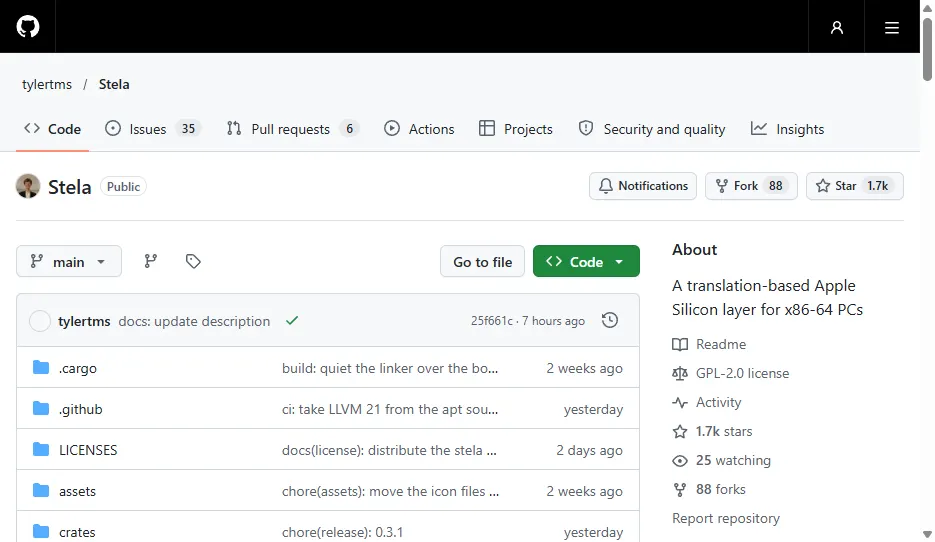
Stela is not a virtual machine. It is a UEFI boot program ??the first thing your PC runs after firmware ??with three major pieces (all details from the README and repo):
- A binary translator. An ahead-of-time and just-in-time compiler that translates arm64e code to x86-64. It covers more than 3,000 AArch64 instruction encodings, maps guest registers directly to host registers, and caches translated code so hot loops don't re-translate.
- A GPU driver. A Metal driver that compiles AIR (Metal's shader IR) directly to NIR (Mesa's IR), supporting the Metal3 and Apple7 GPU families on NVIDIA GTX 16 and RTX 20/30/40/50 series cards.
- A hardware model. The glue that makes the whole machine look like a Mac mini (M2) to the operating system ??which is why an unmodified macOS 27 installer can boot at all.
HN commenters converged on calling it a "bare-metal / type-1 emulator" by analogy to a type-1 hypervisor: there is no host OS underneath, Stela itself is the platform. One thread spent forty comments on whether translation-based systems count as "emulators" at all ??technically Stela does what Rosetta does (translate machine code), not what Wine does (reimplement APIs on the same CPU). For a general-audience article, "emulation via translation" is the honest shorthand.
An interesting wrinkle surfaced in the HN discussion: macOS 27.2 still ships an x86_64 kernel binary inside its seed builds, apparently because Rosetta 2's design requires x64 copies of system components to exist. Commenters noted this with amusement ??it does not mean Apple is returning to x86 Macs, but it does explain why the macOS build system hasn't fully divorced x86 yet.
How mature is it, honestly?
Read the README warning as a contract:
Stela is still in development. It is slow and still may not boot on supported hardware. Fixes are on the way, please submit a GitHub Issue with your boot logs if you encounter an error!
That is a v0.1.0 disclaimer written by someone who expects your machine to fail to boot. The repository has ~6,700 commits and 1.1k stars within days of front-page attention, plus 51 forks ??active development, real traction, but not field-tested stability. The project's own support path is "if it doesn't boot, save a boot log with stela setup boot-log and file a GitHub Issue." That is the workflow of a project where failure is the expected first outcome, not the edge case.
Install effort is moderate: download the stela binary, run sudo ./stela setup (or stela.exe on Windows), let it erase a USB stick, then boot from it. Setup downloads macOS over the network and asks you to pick the macOS version and Mac model. Building from source is heavier ??the first cargo xtask dist fetches and compiles Linux, Mesa, and LLVM sources, which the README warns "takes a long time."
Performance expectations
There are no published benchmarks yet, so everything here is directionally reasoned, not measured:
- The README's own warning says Stela "is slow." The submitter's HN comment repeats it. [unverified] ??no numbers exist for how slow.
- Translation overhead is the dominant cost. Rosetta 2's x86-64?�arm64 translation on Apple hardware is famously close to native in many workloads, but Apple had years of tight hardware/software co-design. Stela is a 2026 project translating the other direction with a much smaller team, and macOS has never been optimized to run translated. [unverified] Expect a meaningful multiple slower than native; treat "usable for daily work" as unproven.
- GPU work depends on the AIR?�NIR Metal driver compiling shaders correctly and quickly. Metal gaming on NVIDIA hardware through a brand-new driver is the single most fragile link. [unverified]
If you want a baseline intuition: think QEMU TCG-style translation costs, with the caveat that Stela's AOT+JIT design aims well above QEMU's interpretive floor. No benchmark exists to confirm that yet.
The compatibility-path comparison
| Path | What it runs, where | Technique | Maturity | Legal status |
|---|---|---|---|---|
| Rosetta 2 | x86-64 Mac apps on Apple Silicon Macs | Apple's own JIT translation (x86?�arm64) | Production, shipping since 2020 | Fully Apple-sanctioned |
| Stela | Apple Silicon (arm64e) macOS on x86-64 PCs | AOT+JIT arm64e?�x86-64 translation + platform emulation, bare metal | v0.1.0, "slow, may not boot" | GPL-2.0 tool is fine; macOS-on-PC violates Apple's EULA |
| QEMU / UTM / virtualization | macOS as a guest VM (on x86 hosts via TCG, or Apple Silicon hosts via Virtualization.framework) | Full-system emulation or hardware virtualization | Works, but macOS guests on non-Apple hosts are slow and equally EULA-bound | Same EULA problem; performance penalty worse |
| Wine / Proton | Windows apps on Linux (and x86 Mac apps via the old Rosetta+CrossOver paths) | API reimplementation ??no CPU translation | Production-grade for a huge app catalog | No Apple license involved; the clean path for Windows software |
The key distinction: Wine and Proton never needed to touch CPU translation because Windows apps and Linux already speak x86-64. Stela's problem is fundamentally harder ??it must translate every instruction and fake an entire hardware platform.
The dealbreaker section: Apple's EULA
This is where honesty matters more than enthusiasm. Stela's own README says: "Stela contains no Apple software. You are responsible for following Apple's software license agreement and terms of use." That is legally accurate for the tool itself ??GPL-2.0 code that translates instructions doesn't violate anything.
But the thing you'd actually run ??macOS ??is licensed, not sold, under Apple's software license agreement. The macOS SLA grants you a license to install macOS on a single Apple-branded computer you own or control. Running it on a DIY PC, a Dell, or a Framework is not covered by any license tier, and buying a retail macOS license does not change that ??the Apple-branding clause applies regardless of how you paid. This is the same wall the Hackintosh community has hit for fifteen years.
Practical consequences, stated plainly:
- Commercial use is effectively off the table. Running your business's macOS tooling on PC hardware puts you outside the license with zero ambiguity, and unlike a plugin dispute, this is the core license for the OS itself.
- Nothing here is legal advice. Enforcement against individuals is rare, but "rarely enforced" and "permitted" are different things, and a project blog that pretends otherwise is doing you a disservice.
- Even the Hackintosh-sympathetic HN thread treated this as background noise, not permission. The debate was about hardware economics and nostalgia, not about whether the EULA allows it.
So the correct framing for Stela's promise is not "run macOS on your PC for free" ??it is "a technically impressive, legally gray platform emulator that some people will run anyway, the way people always have."
The Tech × Money frame: who would this actually save money for?
The pitch writes itself ??stop buying Mac hardware ??and then dissolves on contact with reality:
- The Mac mini math is brutal. An entry Mac mini has long been the cheapest way to legally run macOS, and HN commenters noted that in the early 2020s it made Hackintoshing pointless: "easier to just buy a Mac Mini M2/M4 than bother." Stela doesn't change that math today ??it adds hours of setup and a likely-failed boot to a machine that still needs an NVIDIA GPU and 8 GB+ RAM.
- The real candidate user: someone with a serviceable x86 PC and one macOS-only obligation ??Xcode for iOS builds being the canonical example HN users raised, since you cannot build and ship iOS apps without Apple's toolchain. But that is precisely the most EULA-sensitive, least fault-tolerant use case. A stalled CI machine at v0.1.0 is not a development platform.
- Where Stela's value is real today: binary-translation research, understanding how macOS boots, and the long-game bet that a mature Stela changes the "second-hand Mac hardware vs. PC you already own" tradeoff for hobbyists who have accepted the EULA gray zone.
- The irony worth noting: the same translation infrastructure that runs macOS-on-PC could, in principle, boot other arm64 operating systems built for Apple Silicon on x86 hosts ??but the maintainer's stated intent on HN is running the Apple Silicon version of macOS, and nothing else is supported today. [unverified]
If you want to spend $0 to run someone's apps on the PC you own: Wine and Proton remain the legitimate, mature answer for Windows software. For macOS software, the only sanctioned platform is Apple hardware.
Wrap-up
- Stela is a genuine engineering achievement ??a bare-metal arm64e?�x86-64 translator plus a Metal?�Mesa NVIDIA driver that boots unmodified macOS 27 on PC hardware. It is also a v0.1.0 project that warns you it may not boot.
- The money argument doesn't close yet: performance is unbenchmarked and admitted to be slow, the hardware support matrix is narrow, and the Mac mini remains cheaper than the risk.
- The EULA wall is structural, not technical: Apple licenses macOS to Apple-branded hardware only, and no compatibility layer ??however clever ??changes that. Watch Stela as a research project; don't build a business on it.
Sources
- tylertms/Stela ??GitHub repository (README, hardware requirements, license)
- Hacker News discussion ??"A general purpose Apple Silicon layer for x86-64 PCs" (118 points, 48 comments)
- Apple software license agreements ??macOS SLA (Apple-branded computer clause)
- proomt coverage ??Stela summary and takeaways (Nov 11, 2026)
- Apple Support ??Using Intel-based apps on a Mac with Apple silicon (Rosetta 2 reference)