CES 2027 Preview: AMD Zen 6 vs Intel Nova Lake — and the DDR5-8000 Tax Nobody Is Pricing In
AMD teases Zen 6 at CES Jan 5; Intel confirms Nova Lake on 18A-P. What DDR5-8000 demands from new platforms mean for your build cost.
By Bongyeon Kim · Researched from primary sources, verified by hand, and produced with AI assistance on a production stack this site actually operates (Vercel · Neon · Cloudflare R2).
TL;DR
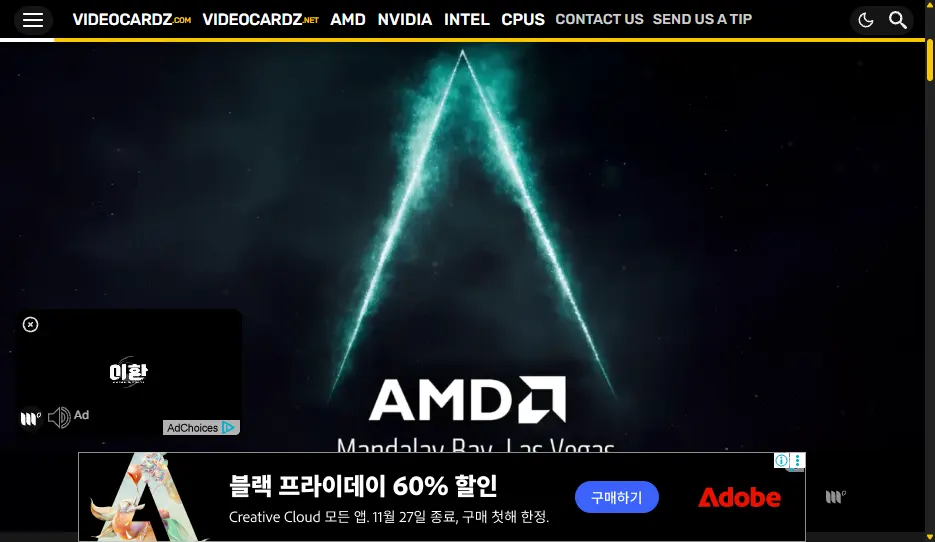
The next desktop CPU generation lands in six weeks, and both vendors confirmed their hands this month: AMD sent CES 2027 invitations for a January 5 keynote (10 AM PT, Mandalay Bay) with an A-shaped teaser — TechPowerUp reads the peak-shaped motif as "Olympic Ridge," the Zen 6 Ryzen desktop codename — while Intel's CEO confirmed on the Q3 2026 earnings call that Nova Lake will be the first client product on its own 18A-P node, with more details at CES. Both platforms leak specs pointing at DDR5-8000. The buyer angle everyone is missing: with DDR5 kits already up 372–485% year over year, a CPU platform that requires faster, more expensive memory turns a CPU upgrade into a full-board-and-RAM rebuild. Here's what's confirmed, what's leaked, and what we'd do with a December build budget.
What AMD is bringing to Mandalay Bay
Confirmed facts first:
- The keynote is January 5, 2027, 10 AM PT — invitation reported by multiple outlets, teaser posted by Jack Huynh (SVP & GM, Computing and Graphics Group) promising "a glimpse of what comes next" / "the next era of computing."
- Zen 6 exists in shipping silicon already: AMD's EPYC 9006 "Venice" server line (Zen 6 architecture) launched with SP7 platforms shipping since November 10 — so the architecture is proven; the question is the consumer packaging.
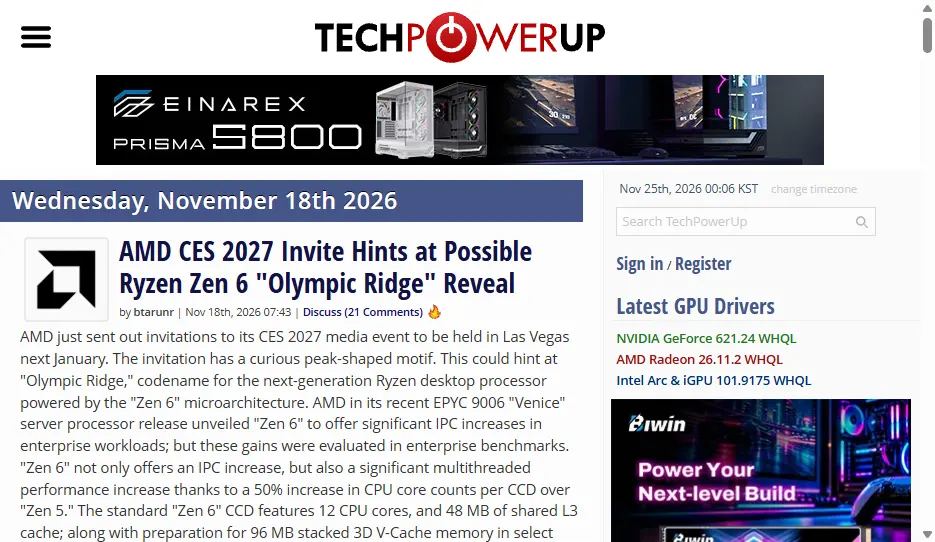
[unverified] Leaks and inference, clearly separated: the CES invitation's peak-shaped graphic is read by TechPowerUp as a hint at "Olympic Ridge" — codename of the Zen 6 Ryzen desktop line. TechSpot notes the same risk we do: it could also be RDNA 5 GPUs or another AI reveal. Additional leaker-reported details (Ryzen AI Max 400 branding for mobile, "Siren Halo" parts pairing Zen 6 cores with RDNA 5 graphics) come from a single-leaker chain — treat as rumor.
What makes Zen 6 credible rather than hyped, from the EPYC data: per-CCD core counts up 50% over Zen 5 (12 cores per standard CCD, 48MB shared L3), with prep for 96MB stacked 3D V-Cache — the X3D line is where AMD's gaming crown lives, and Nova Lake is openly aimed at it.
What Intel just confirmed (and what leaked around it)

Three solid confirmations from Intel's own communications:
- Nova Lake will be the first client product built on Intel Foundry's enhanced 18A-P node — CEO Lip-Bu Tan, Q3 2026 earnings call. The original plan to outsource the compute tile is reversed: this is a foundry-trust statement as much as a product one.
- The new CPU core debuts on desktop first — VP Robert Hallock telling enthusiasts to "do the math" — a direct shot at AMD's X3D gaming segment, echoing through Nova Lake positioning against X3D chips.
- Capacity is being reshuffled to feed it: Intel is taking Panther Lake capacity offline to build more Granite Rapids data-center CPUs — the same "AI first" supply pattern we track on the NVIDIA side, now inside Intel's own fabs.
[unverified] The leak pile, each item single-source: a 28-core Nova Lake-S engineering sample hitting 5.2 GHz in a Linux listing (Nov 5); Advantech materials showing a 16-core Nova Lake-H with 4.8 GHz boost, 25 W TDP, 18MB last-level cache — and DDR5-8000 memory support.
The DDR5-8000 tax nobody is pricing in
Here's the part that turns a CPU launch into a memory bill. Both new platforms leak or confirm support for DDR5-8000 — and memory is the one component already in a historic price spiral:
- DDR5 kit prices rose 372–485% year over year as of August (PCPartPicker data), with November adding another +8.6% month-over-month (3DCenter).
- Samsung, SK hynix, and Micron have sold out 2027 capacity; NVIDIA's $390B commitments sit at the front of that queue.
- A platform demanding DDR5-8000 means the cheap-JEDEC-kit era of mid-range builds is over for early adopters: validated high-speed kits are the premium end of a premium market.
Worked example for a December-vs-January decision (street prices, illustrative): a Zen 5/AM4-holdover builder eyeing Zen 6 today prices a CPU + board + 32GB kit. The same three-part basket in January — Zen 6 CPU + new board + 32GB DDR5-8000 validated kit — carries a memory line that could plausibly double the platform cost versus the builder who upgrades CPU on an existing board and keeps existing RAM.
That's the trap: on new platforms, "CPU upgrade" and "memory upgrade" stop being separate purchases. The CPU prices at CES will be quoted everywhere; the DDR5-8000 kit prices those CPUs require will decide whether the upgrade is rational.
Buy in December or wait for CES?
| Your situation | Our read |
|---|---|
| Current board + RAM, CPU is the bottleneck | Wait 6 weeks — Zen 6 on AM5 (if backward compatible) or Nova Lake pricing lands at CES, and today's purchase is last-gen pricing on a dying cadence |
| Building a full PC in December | Buy parts that don't decay: case, PSU, storage at today's prices; treat RAM/GPU as the volatile lines |
| Gamer eyeing X3D vs Nova Lake | Both refresh at CES; neither launches at CES — real availability is 1H27. Don't pay December premiums on rumor |
| On AM4/DDR4 holdover | Your platform is out of the loop regardless — the DDR5-8000 requirement is another year of life for old cheap kits |
We said it in the Q3 NVIDIA piece and it applies to CPUs too: in a memory-constrained market, every new platform is a bid for scarce DRAM. CES will announce CPUs; the memory market will decide what they cost to own.
Data and follow-ups
AMD keynote details from the reported invitation (Jan 5, Mandalay Bay); Intel statements from the Q3 2026 earnings call via Tom's Hardware; codename and spec-leak context from TechPowerUp, VideoCardz, and NotebookCheck — leaks are labeled above. Memory pricing from PCPartPicker aggregates and 3DCenter's index, allocation context from our NVIDIA Q3 FY27 piece. Follow-up planned after the CES keynote (Jan 5): confirmed SKUs, board pricing, and the real DDR5-8000 kit prices.
Related Posts
- November Memory Price Reality Check: Consumer and Enterprise Are Now on Different Paths2026. 11. 24
- NVIDIA's Q3 Numbers Explain Why GeForce Won't Get Cheaper: $390 Billion in Supply Commitments2026. 11. 24
- Jensen Huang Resigns: The Sequel to Yesterday's Report, and What It Means for Buyers (2026)2026. 11. 12