NVIDIA's Q3 Numbers Explain Why GeForce Won't Get Cheaper: $390 Billion in Supply Commitments
NVIDIA Q3 FY27: $115.8B revenue, $390B in supply commitments, gaming folded into Edge Computing. Worked math on why no CEO change moves GPU prices.
By Bongyeon Kim · Researched from primary sources, verified by hand, and produced with AI assistance on a production stack this site actually operates (Vercel · Neon · Cloudflare R2).
TL;DR
NVIDIA's Q3 FY2027 report (quarter ended October 25, 2026) is the clearest document yet on why gamers keep waiting for GPU prices that never come. Revenue hit $115.8B (+103% YoY), data center took $107.6B of it, and the number that actually matters for graphics cards is buried in the fine print: supply commitments grew from $279B to $390B in one quarter, mostly long-term memory purchases. SK hynix says DRAM and HBM capacity is booked into 2029. Gaming no longer even reports separately. Every fact below is from NVIDIA's press release, the analyst call, and TechPowerUp price tracking — with the unverified rumors labeled as such.
The quarter in five numbers
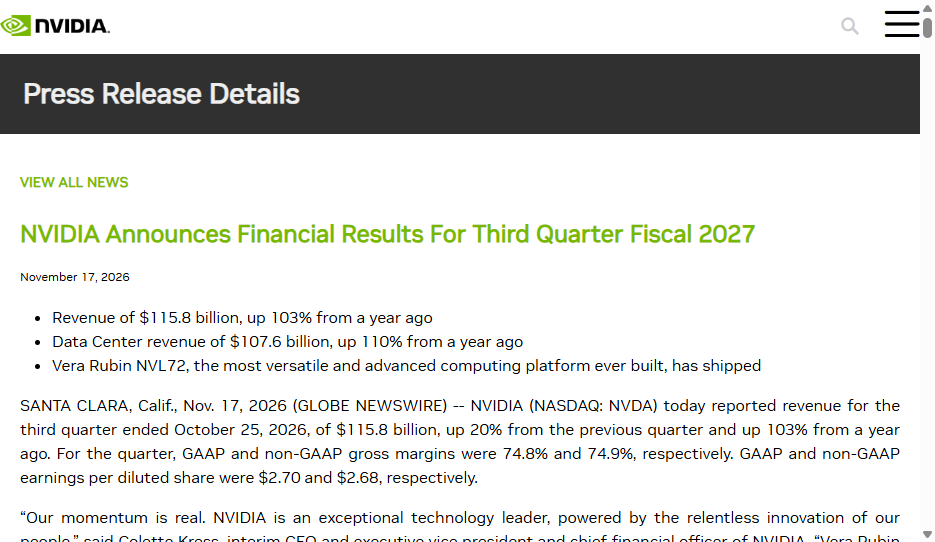
| Number | Value | Why it matters to a GPU buyer |
|---|---|---|
| Q3 revenue | $115.8B (+103% YoY, +20% QoQ) | Beat NVIDIA's own $108B guidance |
| Data center | $107.6B (+110% YoY) | ~93% of the company; the priority queue |
| Edge Computing (incl. GeForce) | $8.2B (+42%) | ~7% of revenue — and no longer a separate line |
| Supply commitments | $279B → $390B in one quarter | Memory locked up years ahead |
| Q4 guidance | $130B | Kress: "Vera Rubin is off to an explosive start" |
Two structural facts hide inside that table:
- Gaming is no longer reported separately. NVIDIA merged GeForce into "Edge Computing" alongside RTX Spark laptops and automotive. When your product line disappears from the revenue report, you are no longer a product line you can defend in a board meeting — you are a segment of something bigger.
- The commitments number is the memory story in one figure. The increase "is primarily attributed to expensive memory purchased under long-term agreements." That is the same memory sitting in the GDDR7 modules on graphics cards — SK hynix has publicly said DRAM and HBM capacity is booked through 2029.
The leadership drama, condensed to what matters
The analyst call was dominated by governance, not product: board chair Harvey Jones said the board does not intend to reinstate Jensen Huang, after Huang said he was willing to return. Questions about the circumstances of the resignation and the ongoing investigation were refused on the call. Colette Kress remains interim CEO while holding the CFO role; no permanent successor has been named, and the next scheduled event is GTC Washington, D.C., November 30 – December 3.
Reports circulated that Huang and Kress had disagreed over NVIDIA's customer-financing arrangements — Huang favoring the guarantees that create demand, Kress favoring reduced exposure. NVIDIA has not confirmed any of this, so treat it as reported context, not fact.
Why $390B means GeForce stays expensive
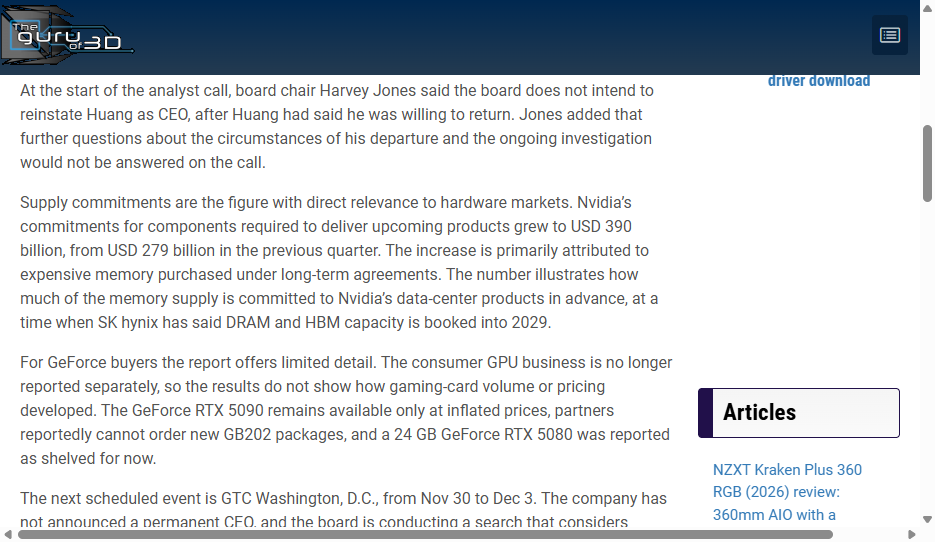
The optimistic argument goes: new CEO, maybe gaming gets prioritized, prices fall. The manufacturing reality is less kind, and analysts like Ian Cutress have laid out the arithmetic:
- A wafer is ~6 months from order to silicon, before packaging, boards, and assembly. A policy change today cannot produce a retail card this quarter.
- HBM and GDDR come from the same tight industry. Even if NVIDIA shifted allocation, GDDR7 supply is constrained by the same 2029-booked capacity the $390B is drawn against.
- Data center wins every internal trade. One HBM module sells for multiples of a GDDR7 module; every wafer-hour is more profitable as a server accelerator.
What did prices actually do this year? TechPowerUp's tracking: RTX 5090 hit a $9,400 cheapest-in-stock US price in October — 370% above its $1,999 MSRP — with a Newegg restock starting at $6,599 in November. RTX 5080 sits around $1,500 against a $999 launch. The rumored 24GB RTX 5080 was canceled (Board Channels report, 11/11 — never officially confirmed), and a wider SUPER refresh was reportedly shelved over GDDR7 pricing.
[unverified] Claims that NVIDIA stopped allocating GB202 to the RTX 5090 entirely, and that the Rubin-based GeForce RTX 60 series has slipped to 2028 (leaker Kopite7Kimi), remain unconfirmed. NVIDIA's official line covers neither.
The buyer's read for December
- Do not pay a rumor premium. Every date in this story is provisional until someone with a press release says otherwise — and nothing in the Q3 release changes card availability this quarter.
- The AI-financing pullback doesn't help you. Even a retreat from circular financing frees wafer capacity on a 6-month-plus lag, and GDDR supply is the binding constraint, not silicon allocation.
- If you need a card, buy what's available at your ceiling. We said it in the 24GB-5080 piece and the resignation piece; the $390B commitments figure makes it more, not less, true.
- Watch GTC Washington (Nov 30 – Dec 3) for the only signal that could change anything: a named permanent CEO with a stated consumer allocation.
How long can a gamer rationally wait?
The "should I wait" question needs a schedule, not a shrug. Working from the measured constraints:
| Horizon | What could change | Rational for a buyer |
|---|---|---|
| Now – Dec 3 (GTC Washington) | Permanent CEO named; possible consumer-allocation statement | Safe to wait this long — but expect nothing concrete |
| 1H27 | Contract memory settlements; the shelved SUPER refresh could revisit pricing | The first window where something could soften — verify, don't pre-order |
| 2Q27 | TrendForce's modeled NAND relief; NVIDIA's 6-month wafer lag from any policy change | Earliest plausible real softening, and only if contract hikes stop executing |
| 2028 | Rumored RTX 60 (Rubin) generation [unverified] | The honest horizon for "new generation at new prices" |
The uncomfortable summary: a 5090 buyer waiting for $1,999 is effectively waiting for 2028 or later, and even 5080-class relief depends on memory contracts, not on NVIDIA's goodwill. Our recommendation stays the same as it was before this earnings report: if your current card dies, buy what's available at your ceiling. If you're upgrading for pleasure, the data says waiting has a defined cost too — every quarter of waiting is another quarter of playing on a card that's worth less every month, with no guaranteed end date on the other side.
[unverified] The 2028 RTX 60 timing and GB202 allocation stop both remain leaker claims. If either is confirmed at GTC Washington, this table changes — that's the point of watching it.
Data and follow-ups
Figures from NVIDIA's official Q3 FY2027 press release and the analyst call, price data from TechPowerUp and Tom's Hardware tracking, capacity timelines from SK hynix and Micron earnings calls. Continuity with our Jensen resignation coverage and the canceled 24GB RTX 5080 report; next checkpoint is GTC Washington, early December.
Related Posts
- CES 2027 Preview: AMD Zen 6 vs Intel Nova Lake — and the DDR5-8000 Tax Nobody Is Pricing In2026. 11. 25
- November Memory Price Reality Check: Consumer and Enterprise Are Now on Different Paths2026. 11. 24
- Jensen Huang Resigns: The Sequel to Yesterday's Report, and What It Means for Buyers (2026)2026. 11. 12