November Memory Price Reality Check: Consumer and Enterprise Are Now on Different Paths
TrendForce Nov 17-18 data: NAND spot-contract gap exceeds 20%, enterprise SSD cuts delay relief to 2Q27, retail prices keep climbing.
By Bongyeon Kim · Researched from primary sources, verified by hand, and produced with AI assistance on a production stack this site actually operates (Vercel · Neon · Cloudflare R2).
TL;DR
The memory market has split in two, and November's data makes the split measurable. Spot prices are softening — DDR4 chips slipped 1.43% this week while DDR5 spot held steady — but that's the wholesale signal, not the retail one. TrendForce's new research says enterprise SSD demand cuts mean NAND price relief is postponed to 2Q27, memory makers are still planning contract hikes, and the spot-contract price gap has widened beyond 20%. Translation: retail prices keep climbing for months even if the spot market cools. If you're building a PC in December, the deciding numbers are the contract ones.
Two markets, two price paths
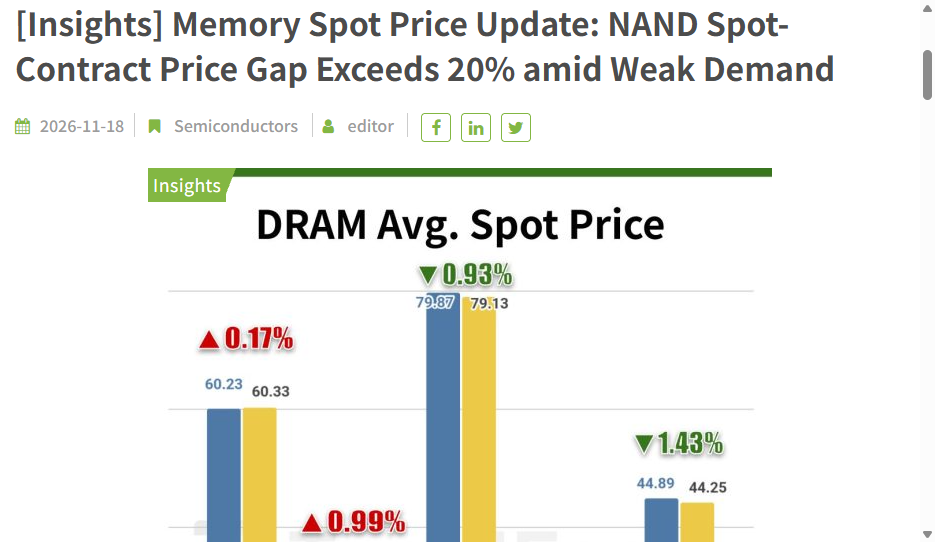
The disconnect is between three layers that used to move together:
| Layer | November state | Source |
|---|---|---|
| DRAM spot | Cautious buyers; branded DDR5 steady, DDR4 weak (1Gx8 3200MT/s −1.43% to $44.25) | TrendForce spot update, 11/18 |
| Contract | Makers still planning hikes; AI demand holds enterprise allocation | TrendForce news, 11/12 |
| Retail | Prices still climbing month-over-month | 3DCenter: DDR5 kits +8.6% MoM in Nov |
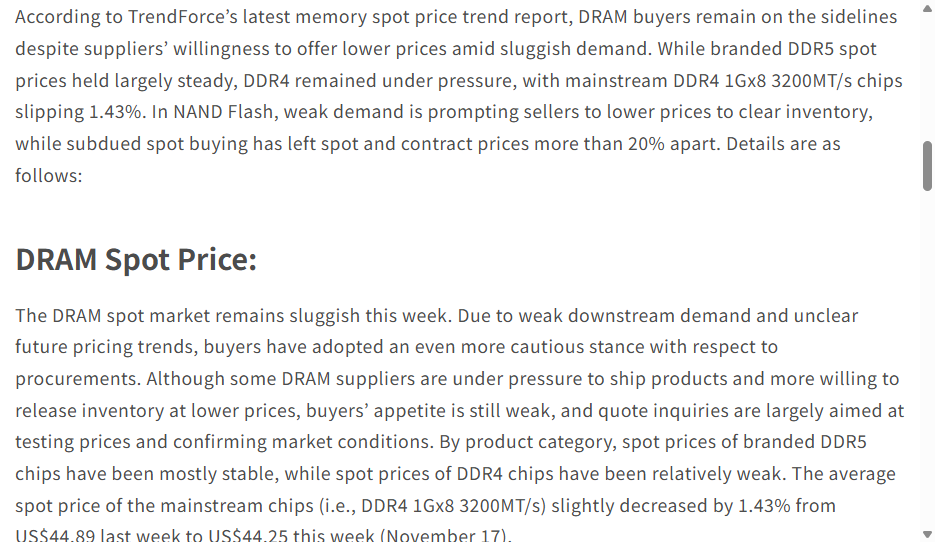
[unverified] Chinese market reporting (Lanjing News via TrendForce) claims Shenzhen street prices for 16GB DDR5 modules (~RMB 1,600) sit below the reported contract price (~RMB 2,000) — a sign the consumer distribution chain is lagging, or unloading old inventory. Worth watching: the same lag appeared before the last price reset.
Why the enterprise side changed the story
The November 17 TrendForce research note is the month's most consequential document: Chinese cloud service providers cut enterprise SSD orders — squeezed by GPU shortages, high inventory, and weak AI monetization — and TrendForce now models NAND price relief pushed to 2Q27 instead of earlier. In plain terms:
- The big AI-driven demand wave that bought 2026's supply is the enterprise queue, not yours.
- Enterprise SSD demand cutting doesn't immediately free NAND for retail — it first unwinds the contract backlog that makers had priced into 2H26–1H27.
- Meanwhile NVIDIA's $390B supply commitments (long-term memory agreements, Q3 FY27) keep the front of the allocation queue locked — SK hynix says DRAM/HBM is booked into 2029.
[unverified] The chain from "Chinese CSP cut orders" to "your December SSD price" is a modeling chain, not a direct quote: the 2Q27 relief date is TrendForce's projection, and projections in this market have missed in both directions this year.
Spot vs contract: the 20% divorce
The spot-contract gap exceeding 20% is the technical signal that retail relief is not imminent:
- Spot reflects today's desperate-clearing and bargain-hunting. Sellers lowering prices "to clear inventory" is exactly what a soft spot market does.
- Contracts are set quarterly and reflect allocation, not spot. Retail price lists track contract prices with a lag, and vendor backlogs push the lag out further.
- So spot softening today is consistent with retail prices staying high through 1Q27 — the 2Q27 date TrendForce models is when contracted supply could repriced into channel inventory.
The consumer signal to watch isn't the spot chart; it's contract renewals and whether makers actually execute the hikes they're "reportedly planning."
China's capacity is the wildcard on the other side
Every relief timeline above assumes the incumbent big three keep the queue. The challenger data says the other end of this shortage may arrive faster — from Chinese manufacturers — and it's already measurable in NAND:
- YMTC's commodity NAND flood is already moving spot prices. BofA-reported data shows commodity NAND spot prices slid ~20% as module makers clear inventory, with China's YMTC scaling output and its eSSD share jumping from 26% to 48% in a year (Sedaily, 11/16). TrendForce adds that YMTC's aggressive market-share push "adds headwinds to further price hikes" — meaning the enterprise-consumer divide above is partly a YMTC story.
- YMTC raised $4.9B in a November funding round and moved closer to IPO (EE Times); Morningstar models it reaching 18% global NAND share by 2028. [unverified] Its H1 enterprise revenue reportedly grew 700%+.
- CXMT is the DRAM side of the same story. Revenue up 613% YoY, DDR5 yields reportedly above 90% [unverified — industry reports], a legacy/commodity offensive that has lifted it to ~10% DRAM share, and Shanghai/Hefei fabs that could more than double capacity past 600k wafers/month (Reuters via Korea Herald).
- The glut warning is explicit: the "DRAM godfather" Kau warned that CXMT's ~10-fab ramp within two years could flip this shortage into a global supply glut (TrendForce, 11/11) — the same risk we flagged in our CXMT expansion piece.
For the December buyer this cuts both ways: Chinese capacity is why the consumer segment could see genuine relief in 2027 even while AI/HBM stays booked to 2029 — but it's also why today's spot softness doesn't equal tomorrow's retail relief. The divide in this article isn't just enterprise-vs-consumer; it's increasingly the big three's contract market against Chinese commodity supply.
What it means for a December PC build
| Component | Decision math |
|---|---|
| DDR5 kit | Buy when you see an acceptable price; waiting for a drop has a 2Q27 ceiling at best — and raises if contract hikes execute |
| SSD | Larger-capacity deals are the first to look stale if NAND relief lands 2Q27 — but no panic needed; capacity-tier pricing has more slack |
| GPU | Memory-adjacent but its own story — GDDR7 supply is locked into 2029 under NVIDIA's commitments (our Q3 FY27 piece covers it) |
We said it in the DDR5 crisis piece and it holds after November's data: the scarce resource is committed capacity, not produced capacity. Anyone waiting for 2026-style prices is waiting for the enterprise queue to shrink, and that queue just got a multi-year contract extension.
Data and follow-ups
Spot data from TrendForce's November 17–18 updates; enterprise demand analysis from the November 17 research note; retail deltas from 3DCenter's German price index; allocation context from NVIDIA's Q3 FY2027 release. Follow-ups: our DDR5 price crisis explainer and Samsung/SK DRAM share piece cover the structural side; next update when TrendForce publishes December contract settlements.
Related Posts
- CES 2027 Preview: AMD Zen 6 vs Intel Nova Lake — and the DDR5-8000 Tax Nobody Is Pricing In2026. 11. 25
- NVIDIA's Q3 Numbers Explain Why GeForce Won't Get Cheaper: $390 Billion in Supply Commitments2026. 11. 24
- Jensen Huang Resigns: The Sequel to Yesterday's Report, and What It Means for Buyers (2026)2026. 11. 12