A $300 Machine Demanded a Subscription, So Its Owner Built a Free App: The Subscription-Hardware Pattern (2026)
He refused to pay $12.99/mo to fully use his own $300 embroidery machine, so he built a free app. The subscription-hardware pattern, decoded.
By Bongyeon Kim · Researched from primary sources, verified by hand, and produced with AI assistance on a production stack this site actually operates (Vercel · Neon · Cloudflare R2).
You can buy a fully functional embroidery machine for about $300. It sews real stitches onto real fabric, right now, with no network connection required at the moment of sewing. And yet the manufacturer designed it so that the only way to drive it — to give it anything to sew — is through a phone app with a paid tier. The machine you own outright needs a monthly payment before its useful features unlock.
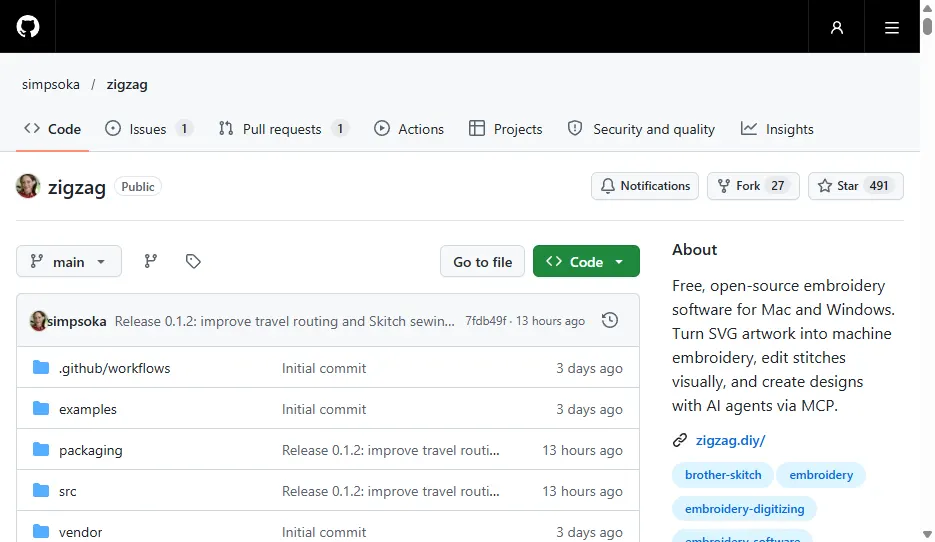
That is not a hypothetical. That is the Brother Skitch PP1, and one of its buyers got so annoyed that they built an entire open-source replacement suite instead of paying. The result is ZigZag, a free Rust-based embroidery editor that hit the front page of Hacker News in November 2026 with 500+ points, and it is the cleanest case study yet in a pattern that is quietly spreading across every category of hardware you "own."
TL;DR
- The Brother Skitch PP1 (~$300 on Amazon, $499.99 MSRP) is an app-operated machine: Brother's own product page states "Artspira is required to use the machine."
- Artspira's free tier transfers basic designs; the useful stuff — importing your own designs, digitizing, advanced editing — sits behind Artspira+ at $12.99/month or $119.99/year.
- A buyer (GitHub user simpsoka) built ZigZag instead: a free, Apache-2.0 embroidery editor in Rust that turns SVGs into stitch files, exports PES/DST/EXP/JEF/VP3, and sends designs straight to the Skitch over Bluetooth using a reverse-engineered protocol.
- The wider pattern is everywhere: BMW charged $18/month for heated seats already installed in the car, John Deere locked tractor repair software behind dealers until an FTC settlement in July 2026, and Cricut gates cutter features the same way.
- The lifetime math is lopsided: about 5 years of Artspira+ costs roughly what the machine itself costs, and professional embroidery digitizing software runs $79/month subscriptions or $1,000–$4,000 lifetime licenses. ZigZag costs $0 forever.
- The twist of 2026: LLM-assisted reverse engineering has flipped the economics. Writing your own unlock used to cost months of expert work; now a determined owner with an AI coding assistant can do it, and the ZigZag repo even ships an MCP server so AI agents can drive the design editor.
The machine and the gate
First, the hardware. The Brother Skitch PP1 is a single-needle, free-arm embroidery machine with a magnetic hoop, launched at $499.99 and commonly sold around $300. It has no meaningful onboard screen or design input — it is explicitly "app-operated." You design on your phone or tablet in Brother's Artspira app, and the design transfers to the machine over wireless.
That's where the gate sits. Brother's Artspira FAQ is candid about the two-tier structure:
- Artspira Standard (free): transfer designs from the app to the machine, use the basic embroidery drawing tool, browse projects.
- Artspira+ ($12.99/month, or $119.99/year): import your own designs, digitize images into embroidery, cross-stitch conversion, advanced drawing tools, the full design library.
So the raw capability — "put the picture I want onto the fabric" — is physically there in the $300 box, and the toll booth is a $12.99/month app subscription. The Skitch's own listing spells it out: features like importing designs "requires Artspira+ subscription."
The machine's Amazon reviews, as the ZigZag author noted in the HN thread, are largely complaints about the software and the subscription, not the sewing hardware. The hardware works. The business model doesn't.
What ZigZag actually is
ZigZag (Apache-2.0, Mac and Windows) is not a hobby script — it's a serious attempt at a full embroidery digitizing suite:
- SVG to stitches. Import vector art (or trace a PNG/JPEG logo into flat-color shapes), pick a stitch type per object — tatami fill, satin column, running stitch, contour, cross-stitch, appliqué, and more — with underlays, pull compensation, and fabric presets.
- Machine file I/O. Exports PES, DST, EXP, JEF, and VP3 — the formats most embroidery machines accept — and opens machine files for editing. File layouts and Brother's thread palette come from the open-source pyembroidery project, and every writer is verified by reading back through pyembroidery with identical stitch positions.
- Direct Bluetooth to the Skitch. This is the rebellious part. The Skitch's Bluetooth protocol is undocumented; ZigZag reverse-engineered it (crediting earlier protocol work in the repo's NOTICE), so you can send a design, run Brother's "trial run" outline check, and watch stitch-by-stitch progress from the desktop app — no Artspira involved at any step.
- An Illustrator-style editor plus an AI hook. The UI is laid out like Adobe Illustrator, down to the Pen tool and smart guides, and it embeds an MCP server so Claude Code, Codex, or any MCP client can draw and edit designs in the live document. There's also a CLI:
zigzag convert logo.svg -o logo.pes.
The parity tables in the README are the detail that makes this credible: it explicitly checks its feature set against Ink/Stitch (the free Inkscape plugin) and against Wilcom Hatch, the de-facto commercial standard. It's not a demo — it's gunning for the paid incumbents.
How it was built — and why that matters
In the HN thread, the author confirmed the heavy lifting was AI-assisted ("ChatGPT, but close!"), saying they likely wouldn't have started the project if every line had to be hand-written. The Bluetooth protocol reverse-engineering also built on prior published work (jhbruhn's "respira" project, which itself credits AI-assisted protocol analysis). The README even includes a toolkit for continuing the reverse-engineering: a settings-byte diff tool and a Bluetooth capture utility, in case future firmware changes the protocol.
That's the economically interesting bit. Reverse engineering a closed device protocol used to be a specialist skill measured in months. In 2026 it's a determined hobbyist project measured in weeks, with the leftover work documented in a public repo for the next person. The HN thread reads like a catalog of the same playbook starting everywhere: a Peloton owner replacing the $50/month subscription with a YouTube launcher, a YouTuber (William Osman) building a browser-based embroidery tool for his own machine, multiple people asking for a Cricut unlock next.
The wider pattern: hardware you own, features you rent
The Skitch is a small ($300) instance of a very large pattern.
BMW's heated seats. In 2022, BMW's ConnectedDrive store offered a subscription of roughly $18/month to activate seat heating that was already physically installed in the car (or a one-time "permanent" purchase around $406). The backlash was severe enough that BMW dropped the heated-seat subscription in 2023 — while remaining "fully committed" to software-based feature unlocks for other functions. The hardware-software split is standard now: the car ships with the heating element wired in, and a server-side flag decides whether you're allowed to feel it.
John Deere's tractors. Farmers buying $300,000+ combines found that diagnosing and repairing them required dealer-only software; John Deere even argued to the Copyright Office that farmers buy a license to operate the software in the tractor, not the software itself. After years of litigation, the FTC and a coalition of states secured a settlement in July 2026 requiring Deere to make its repair software, manuals, and dealer-level diagnostic tools available to farmers and independent shops. Notably, that covers repair access, not feature access: the software-locked-hardware question is only starting to get legal answers.
Printers and craft cutters. HP built an entire revenue line around Instant Ink, a subscription where the printer itself reports ink levels and mails cartridges — with tiers based on pages printed, not ink used. Cricut, the dominant home cutting machine, gates Design Space features behind a subscription — the Artspira pattern in softer form. The HN comments on the ZigZag thread were, disproportionately, people asking "can someone do this for [Cricut / printers / my car]."
The logic is always the same: the marginal cost of the hardware feature is already paid; the subscription monetizes permission. Hardware becomes a loss leader — the Skitch's author suspects Brother initially sold the machine at a loss expecting to recoup on Artspira+ — and the customer relationship becomes a meter.
The lifetime cost, modeled
Here's an illustrative model of what "owning" a Skitch costs depending on which software route you take. (Illustrative, not a quote: subscription prices are current published rates, held constant; the machine is assumed at $300; a professional digitizing subscription is set at the commonly advertised ~$79/month tier, and a pro lifetime license at ~$1,000, per current market listings.)
| Route | Year 1 | Year 3 | Year 5 | Year 10 |
|---|---|---|---|---|
| Skitch + Artspira+ ($12.99/mo) | ~$456 | ~$768 | ~$1,079 | ~$1,859 |
| Skitch + ZigZag (free, Apache-2.0) | ~$300 | ~$300 | ~$300 | ~$300 |
| Skitch + pro digitizing subscription (~$79/mo) | ~$1,248 | ~$3,144 | ~$5,040 | ~$9,780 |
| Skitch + pro lifetime license (~$1,000 one-time) | ~$1,300 | ~$1,300 | ~$1,300 | ~$1,300 |
Read that first and last row together: in under five years, Brother's app subscription costs more than the embroidery machine it unlocks. Ten years of Artspira+ is roughly six times the price of the hardware. The pro-software market the incumbents defend is even more aggressive — which is why the embroidery community greeted ZigZag the way it did: one commenter described abandoning the hobby's software because Hatch alone crossed $1,000, and another wrote simply that hobbyists "pay absolutely ridiculous money for digitizing software."
The counter-model, of course, is that subscription software funds ongoing development, servers, and support, while a one-time $0 app is one person's side project that may be abandoned tomorrow. That's a fair concern for a business — and largely irrelevant for a protocol reverse-engineering project. The Bluetooth protocol work, the file-format layouts (pyembroidery), and the stitch algorithms (Ink/Stitch's approaches, VectorCraft's tracer) are all open and forkable. If the author walks away, the capability survives in the community in a way that a lapsed Artspira+ subscription never does.
The arc: from owning to renting — and back?
There's a 20-year arc here. Software went from perpetual licenses to subscriptions (arguably with good reasons — continuous updates, lower entry cost). Hardware then followed the software logic: the device is a delivery vehicle for recurring revenue, and the "feature" is whatever a server currently permits. BMW's own spokesperson, after killing the heated-seat subscription, reaffirmed the post-purchase-unlock model; John Deere conceded only what a settlement required.
What's new in 2026 is the counter-pressure from the owner's side. The ZigZag story isn't "a genius wrote a driver" — it's "an annoyed customer could finally afford to rebel." LLM-assisted development collapsed the cost of building competent, spec'd-to-your-needs software and of reverse-engineering undocumented protocols. The top HN comment called it "one of the best examples of the way LLMs can empower users," and the author's own framing was broader: "The days of personalized software are here. I built it exactly to my spec."
Manufacturers will respond — signed firmware, secure boot, protocol encryption are all mentioned in the thread as the predictable next move, and companies now have the same AI tools to harden devices that owners have to open them. But each lock costs money, alienates the exact customers who care most, and — as ZigZag demonstrates — generates the negative publicity that made BMW retreat. The Skitch already shows the market correction loop: a machine bought because its reviews were bad for software reasons, rescued by software its manufacturer didn't ship.
Wrap-up
- Ownership now has fine print. A $300 sewing machine, an $80,000 car, and a $300,000 tractor all converge on the same model: the hardware is sold, the permission is rented. Check what an object needs to talk to before you buy it, and price that dependency over the years you expect to keep the thing.
- The escape hatch is getting cheaper. ZigZag's recipe — open file formats via pyembroidery, community reverse-engineered protocol work, AI-assisted implementation, Apache-2.0 — is reproducible across device categories. Every ZigZag makes the next rebellion cheaper.
- The subscription wins only if the alternative stays impossible. Brother's $12.99/month gate made sense when building the alternative cost a software team. In 2026 it costs one motivated owner, an LLM, and a spare month. The economics of permission are being repriced from the customer's side.
Sources
- ZigZag — GitHub repository (simpsoka/zigzag)
- Show HN: My $300 embroidery machine needed a subscription, so I built my own app — Hacker News discussion
- ZigZag project site
- Brother Skitch PP1 product page ("Artspira is required to use the machine")
- Brother Artspira app page (Standard vs. Artspira+ tiers, $12.99/mo, $119.99/yr)
- Brother press release: Artspira+ introduction and Skitch PP1 launch ($499.99 MSRP)
- TechSpot: BMW admits heated seat subscriptions were a mistake, but the paywalls aren't going away
- Motor1: BMW heated seats subscription is real and it costs $18 per month
- FTC: FTC, States Secure Settlement with Deere & Company, Advancing Farmers' Right to Repair (July 2026)
- NBC News: Right-to-repair revolution — farmers challenge John Deere's control over equipment repair
- Ink/Stitch — free embroidery plugin for Inkscape (feature-parity reference)
- pyembroidery — open-source embroidery file format library (used and verified by ZigZag)