Why Your Next SSD Waits on a Chinese IPO: NAND 2026–2027 Forecast
NAND contract prices rose every quarter of 2026 while YMTC's $4.9B IPO slipped to 2027. What the supply map says about SSD prices next year.
Two stories from last week belong together. NAND flash contract prices rose in every quarter of 2026 — hardest in Q1 (+85–90% quarter over quarter, revised upward from an initial +55–60% forecast) — and China's largest NAND maker, YMTC, just complicated next year's relief math by reportedly delaying its ¥33 billion (~$4.9B) IPO to the first half of 2027. If you buy storage — and every developer does — the map of when prices might actually turn is drawn in that second story.
TL;DR
- Street prices first: the most-tracked 2TB PCIe 4.0 NVMe drives went from ~$135–190 (Nov 2025) to $300–380 (Mar 2026) — +84% to +153% in four months. An 8TB consumer NVMe averaged $1,476 by January 2026.
- Enterprise demand is the engine: enterprise SSDs took 48% of global NAND bits shipped in Q2 2026 (26% a year earlier), with cloud buyers contracting allocation into 2027.
- The IPO delay matters: YMTC's $4.9B raise was funding its aggressive 2×-capacity expansion (three new fabs, ~100K wpm each). Pushing that capital raise to 1H 2027 pushes the supply response — which suppliers already pegged at late 2027 at the earliest — further out.
- Phison's own forecast: the NAND shortage "until 2030". Treat every "prices will ease" date as a negotiation, not a schedule.
The price ladder, quarter by quarter
| Quarter | NAND contract price (QoQ, forecast range) | Cumulative effect on a $100 basket |
|---|---|---|
| Q4 2025 | +33% to 38% | ~1.35× |
| Q1 2026 | +85% to 90% (initial forecast +33–38% → revised) | ~2.5× |
| Q2 2026 | +70% to 75% | ~4.3× |
| Q3 2026 | +10% to 15% (consumer demand cooling) | ~4.8× |
| Q4 2026 (forecast) | +15% to 20% | not published |
Two caveats to keep the table honest: trackers disagree on the exact Q1 figure (different reports quote +33–38%, +55–60%, and revised +85–90% for contract price classes before settlement — TrendForce's own review of the finished quarter walked a 53–58% enterprise forecast up to nearly +80%), and the percentages stack, so a $100 basket at the end of 2025 sat at roughly three times that by late 2026 [unverified as a single index — aggregated from quarter forecasts and vendor data]. But the shape of the curve — a vertical Q1, a hot Q2, a consumer-market breather in Q3, and a re-thickening in Q4 on AI server demand — is consistent across sources.
The street view matches the contract view. GamersNexus's tracked 2TB market: fanxiang S880 $135 → $300 (+122%), Kingston NV3 $150 → $380 (+153%), WD Black SN850X $190 → $350 (+84%). SATA moved less (+~75% vs +~115% for NVMe) — same NAND, different enclosure. Kingston's datacenter business manager separately reported NAND wafer costs up 246% since Q1 2025, with roughly 70% of that climbing in just the trailing 60 days.
Why YMTC's IPO slipped — and why it's a supply story
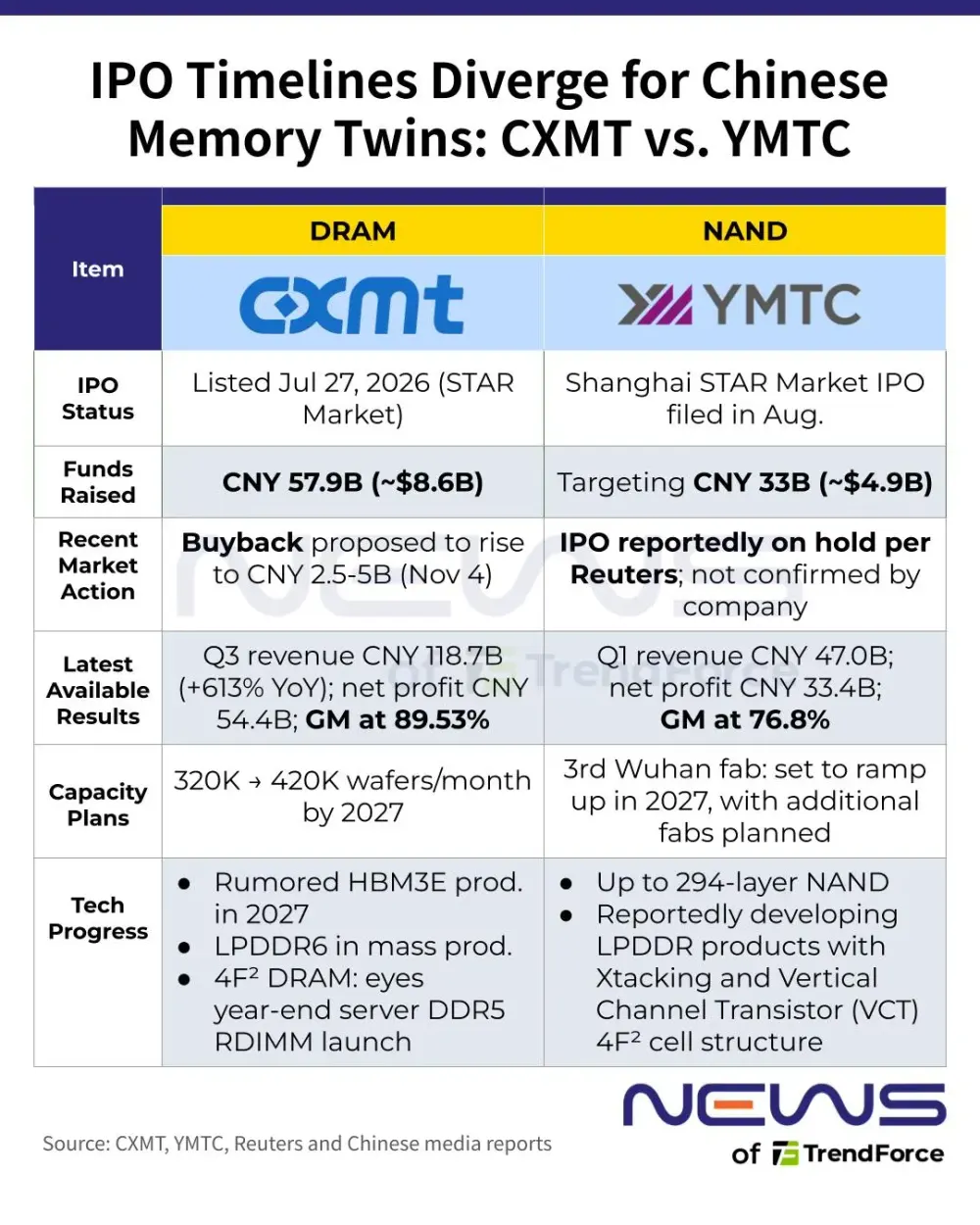
Reuters reported that YMTC's Shanghai STAR Market listing — filed in August by parent CCSH Corporation, targeting about ¥33B (~$4.9B) — has been pushed toward 1H 2027 amid a rout: the CSI 300 fell 8.5% in October alone, the worst month in over a decade, and the STAR 50 index sits roughly 40% below its July peak. Regulators are reportedly asking banks to slow new listings for AI and semiconductor issuers [unverified as an official policy — Reuters/FT reported it as informal guidance, and YMTC hasn't confirmed the delay].
Three consequences travel directly to your SSD checkout page:
- The delayed raise funds the supply response. Reuters documents that YMTC planned three additional fabs of ~100K wafers/month each — a two-fold capacity increase if fully ramped — and has spent ¥14.2B on R&D since 2023. Fab timelines are capital timelines; a slipped IPO is a slipped fab.
- China's market won't rescue Western shelves either. CXMT (DRAM) did list in July 2026 and is buying back stock in the 2.5–5B yuan range to defend its price — evidence that even the listed player is rationing capital while demand-side money waits.
- Enterprise allocation is contractually locked. Enterprise SSDs took 48% of global NAND bits in Q2 2026 (26% a year earlier) and are expected to cross 50% before the year ends. Cloud buyers signed their 2027 allocation already. When a fab makes one more enterprise E3.S module, it makes one fewer 2TB retail drive.
Frontline detail that will age badly or well: TrendForce's Q4 2026 outlook (built Sept 24) still shows consumer NAND contract prices rising +15–20% QoQ this quarter — relief is a 2027 conversation, and the most-cited "balance" date remains late 2027 at the earliest, with Phison pushing 2030. Meanwhile the Gartner-set family line: average PC prices up 17% and shipments down 10%+, because OEMs can't source the same storage at the same cost. Dell and Lenovo are reportedly trimming configurations (SSD capacity downgrades) rather than raising sticker prices further.
The buying math (Tech × Money)
This is the second 5× hardware story on this blog — the DRAM/RAM price crisis post covered memory; NAND is the same engine with one important difference in your favor: consumer SSD demand is elastic, and the Q3 numbers prove it cooled (+10–15% QoQ after two brutal quarters). That gives the buyer an instrument the RAM buyer doesn't have:
- The 1–2TB segment is the last liquid cell. Wide selection of Gen 4 drives is still in stock; the 4TB and 8TB segments took the worst disproportionate spikes. Buy at the segment where competition remains.
- Buy the capacity you need now, and note the exit. A 2TB Gen 4 NVMe at ~$300 buys today what a $135 ticket bought in November 2025. If your workload can wait past late 2027 for a capacity add — and your current drive isn't the constraint — waiting is a position, not laziness.
- Gen 5 is a luxury spend in a scarcity market. The T700-class PCIe 5.0 drives sit at ~$788 for 2TB (Oct 2026 tracking). The bandwidth delta doesn't compound for most real workloads [market-dependent — verify against your own I/O profile].
- HDD remains the bulk tier. Cost per TB is still unbeatable for media and backup, though HDDs are inflating too. Local LLM model files (which ran in the ACEMAGIC mini PC post discussion) can live on spinning rust; your running model working-set belongs on the fastest drive you own.
- Watch enterprise-contract headlines as your leading indicator. Your local SSD price at retail today is largely lagged enterprise contract behavior. When 2027 enterprise renewals stop being signed at crazy premiums — or the first YMTC fab officially ramps — that's the consumer price signal turning, not the other way around.
What the community said
The QuasarZone relay of the news (2 comments in the visible window) stayed polite and procedural — a source-thanks and an "internal strengthening?" / capacity question — which fits the audience: this is a corporate finance story whose hardware impact arrives with a lag. The readers who should care are exactly the ones who treat supply chains as a product feature.
Wrap-up
- NAND prices rose every quarter of 2026, with the enterprise segment pulling ~half the world's bits — a structural reallocation, not a spike.
- YMTC's IPO delay moves the largest funded capacity-expansion plan (three fabs, 2× capacity) out toward 1H 2027 — right around the date suppliers were calling "balance, at the earliest."
- If you're building in this window: 1–2TB, Gen 4, buy-on-need, and watch enterprise contract renewals as the leading indicator for retail relief.
Sources: YMTC/CXMT corporate story via QuasarZone's Nov 5 relay of TrendForce's report (original: Reuters/FT citations therein); contract and street price data from TrendForce/Counterpoint/KB-coverages as aggregated by trade press, gamersnexus.net's tracked street-price table, and Tom's Hardware's January 2026 reporting. All numbers are dated snapshots — re-verify at purchase time.