CXMT's 10 New Fabs Could Flip the DRAM Shortage Into a Glut: What History Says About Timing (2026)
Charles Kau says CXMT's 10 new fabs could flip today's DRAM shortage into a glut. What the 2018 and 2022 crashes teach buyers about timing.
By Bongyeon Kim · Researched from primary sources, verified by hand, and produced with AI assistance on a production stack this site actually operates (Vercel · Neon · Cloudflare R2).
Right now, buying RAM feels like buying eggs during a shortage: everything is sold out and the price goes up while you check out. That is why a warning from one of the few people who has lived through every modern DRAM cycle deserves attention. Charles Kau — "Cow" in the QuasarZone thread, "카우" in the Korean relay — says China's CXMT is building 10 wafer fabs, and that the capacity lands within two years. His point is not that help is coming soon. It is that the same machine squeezing your wallet today can flood the market right after you finish your build.
TL;DR
- "Cow" is Charles Kau (高啟全), former president of Taiwan's Nanya Technology and an ex-Intel/TSMC executive — TrendForce calls him the "Godfather of DRAM." He led early development at China's YMTC, so when he talks about Chinese memory expansion, it is not armchair commentary.
- The TSMC rumor: reports in early November 2026 claimed TSMC was exploring 3D DRAM production at NVIDIA's urging. TSMC officially denied it, and Kau rejects it too — he points to TSMC's affiliate VIS, whose memory venture failed and returned to foundry work.
- Kau's real warning: CXMT is building 10 wafer fabs across Beijing, Shanghai, and other sites [unverified — single-source via TechNews citing Kau], with major new capacity online within two years, which could trigger a global memory supply glut.
- Verified scale is already large: TrendForce pegs CXMT at ~320,000 wafers/month heading to 420,000 by 2027, and Reuters reports planned Hefei and Shanghai fabs that would push capacity past 600,000 wafers/month — near Micron's total.
- History says the flip from shortage to glut is fast and brutal: in 2018 and 2022, DRAM prices went from record highs to double-digit quarterly declines within about 3–4 quarters.
- For buyers: this is not a "wait for cheaper RAM in 2027" article. It is a map of the signals that tell you the cycle has actually turned — capex cuts, module makers' inventory, and the first spot-price drops.
Who Is "Cow"? The Analyst Behind the Warning
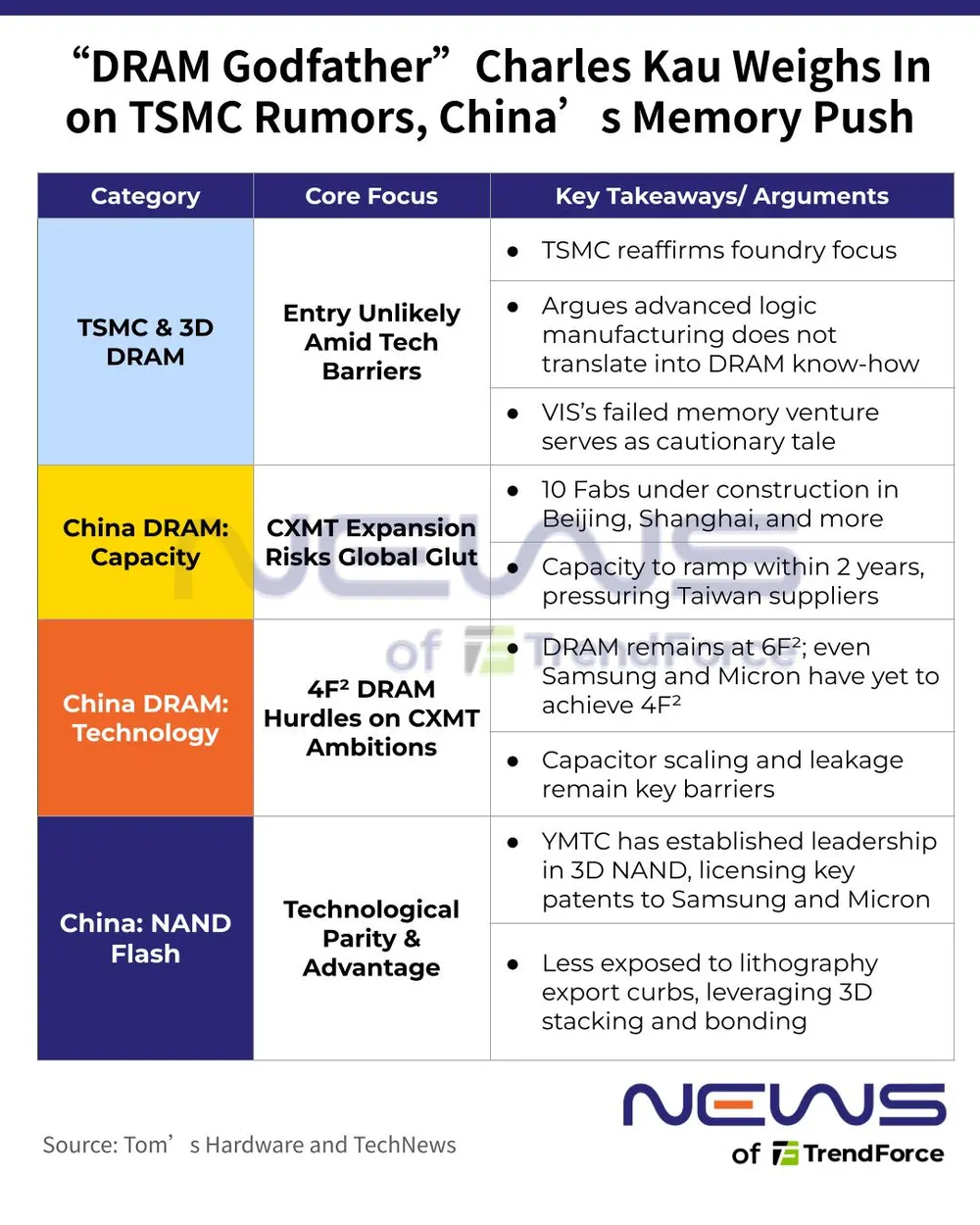
The QuasarZone post that relayed this story translates the name as "카우" (Kau), and the original English source makes the identity clear. TrendForce's November 11, 2026 news piece quotes Charles Kau, former president of Taiwan's Nanya Technology, described as the "Godfather of DRAM." His resume is the reason the market listens: executive roles at Intel and TSMC, then the top job at Nanya, one of the few DRAM makers that survived every consolidation wave. Later he personally led the early development of China's YMTC, which now licenses NAND patents back to Samsung and Micron — per TechNews, citing Kau himself.
Why does this matter for you as a buyer? Because DRAM commentary in 2026 is full of motivated voices. Suppliers want you to believe shortages are permanent; shorts want you to believe collapse is imminent. Kau sits in a rare spot: he has no product to sell, he has run a DRAM P&L, and he helped build the Chinese competitor now scaling. When he says "watch CXMT, not TSMC," it carries weight.
The TSMC-Enters-DRAM Rumor: Debunked, Twice
The rumor chain ran like this: Reuters and The Information reported on November 6, 2026 that TSMC was considering advanced memory production, with 3D DRAM floated at NVIDIA's request. TSMC stock jumped on the report. Three days later, TSMC publicly denied any plan to enter DRAM manufacturing, reaffirming its foundry focus, per Tom's Hardware and Chosun.
Kau's rebuttal adds the industry memory that most coverage skipped: TSMC already tried this. Its affiliate Vanguard International Semiconductor (VIS) entered memory manufacturing, failed, and retreated to foundry work. Kau's argument is structural, not sentimental — advanced logic leadership does not transfer to DRAM, because DRAM is a one-transistor, one-capacitor cell where capacitor scaling and leakage current dominate. Per TechNews, he notes DRAM scaling is still stuck at 6F², with no manufacturer having reached 4F² — including Samsung and Micron.
For buyers, the debunk matters because it removes one imagined source of future supply. TSMC building DRAM fabs was a bull-case fantasy for price relief. Without it, relief depends on the companies already making DRAM — and on CXMT.
CXMT's Expansion: The Verified Numbers vs. the Claimed Ones
Here is where precision counts, because "10 fabs" and "600K wafers" are different claims with different reliability.
Verified, multi-source numbers:
- TrendForce (September 2026): CXMT's monthly DRAM capacity rises from around 320,000 wafers to about 420,000 by 2027.
- Yahoo Finance/analysis cited by TrendForce: CXMT will end 2026 near 350,000 wafer starts per month — only about 25,000 short of Micron's projected 375,000.
- Counterpoint Research: CXMT's global DRAM share jumped from 3% in early 2025 to 8% in Q1 2026; Korean trade press reports it crossed 10% in Q2 2026.
- Reuters: CXMT's July 2026 Shanghai STAR Market IPO made it China's most valuable listed chip company after a 500%+ share surge, and new fabs in Hefei and Shanghai (100,000 wafers/month each) could more than double capacity to over 600,000 wafers/month if completed.
- TrendForce: CXMT posted an 89.53% gross margin in 3Q26 — it is printing money and can self-fund expansion.
The claim you should treat carefully: Kau's "10 wafer fabs under construction, major capacity within two years." This comes through TechNews citing Kau, relayed by TrendForce and QuasarZone [unverified]. It may include announced-but-not-built projects and small packaging/test sites counted as fabs. The direction is supported by Reuters' fab-count reporting, but the exact number is single-source commentary, not a audited fab list.
Also flagged by Kau: CXMT's year-end target of 4F²-based DDR5 RDIMMs is aggressive, and he doubts the architecture reaches mass production on schedule — noting even Samsung and Micron have not cracked 4F² [unverified — analyst opinion]. That matters because the technology ceiling and the capacity ceiling are separate problems. CXMT does not need 4F² to cause a glut; mature-process DDR4/DDR5 wafers in huge volume do that on their own.
When Does Shortage Flip to Glut? What 2018 and 2022 Taught
DRAM is one of the most cyclically violent markets in tech, and the last two crashes followed the same script. The pattern: bit demand surges → suppliers hold capacity and prices spike → record profits fund record capex → new capacity lands just as demand slows → prices crater.
| Cycle | Peak conditions | The turn | The crash, by the numbers |
|---|---|---|---|
| 2018–2019 | DRAM prices at record highs after years of shortage; suppliers adding capacity through 2018 | 4Q18: oversupply appears as smartphone and server demand softens | TrendForce (Sep 2018) forecast a 5% QoQ price decline in 4Q18 "due to oversupply and weak demand." By 1Q19, contract prices were projected to fall 15% QoQ, with PC DRAM down more than 20% QoQ. Industry revenue kept falling into 2019. |
| 2022–2023 | Pandemic PC boom ends; inflation hits consumer electronics | 3Q22: suppliers concede prices to move inventory | TrendForce: 3Q22 global DRAM revenue fell 28.9% QoQ to $18.19B; 4Q22 fell another 32.5% QoQ to $12.28B as suppliers made large price concessions. Consumer DRAM prices bottomed after double-digit quarterly declines through mid-2023. |
Two lessons from both cycles:
- The peak-to-trough turn took roughly two to four quarters. In 2018, "record shortage" in mid-2018 became "15% quarterly price collapse" by early 2019. Nobody rang a bell; TrendForce's own forecasts went from price hikes to price cuts between consecutive quarters.
- Capacity that was ordered during the shortage is what kills the shortage. The 2022 crash was not caused by a demand shock alone — the big three had already committed capex during the 2021 boom. The fabs came online into a demand vacuum.
Apply the script to 2026: TrendForce projects memory supply growing about 23% in 2026, SK Hynix forecasts tight supply through 2028 for commodity DRAM, and analysts quoted in Korean business press expect DRAM and NAND prices to fall 20–30% once 2028 arrives. Digitimes reported in mid-2026 that the shortage could turn into a glut by 2028 as new capacity lands. Blocks & Files, also in 2026, framed the AI memory supercycle as peaking "possibly in 2028" as new fab capacity comes on stream. Kau's glut warning is the same thesis with a sharper edge: CXMT's additions land on top of Samsung, SK Hynix, and Micron expansions — and Chinese suppliers, state-backed and freshly IPO-rich, are the least likely to cut output in a downturn.
The honest caveat: several forces could delay the flip past 2028. AI demand is genuinely structural (HBM crowds out commodity DRAM bit capacity — every HBM wafer produces far fewer bits), DDR4 EOL is removing supply, and equipment lead times now stretch beyond two years. CNBC reported in October 2026 that memory stocks sold off specifically on CXMT competition and oversupply fears — the market is pricing the glut as a 2028+ story, not a 2027 one.
What Buyers Should Watch: The Signals That Precede the Flip
If you are building a PC, upgrading a server, or buying memory for a small business, you do not need to predict the cycle — you need to detect it early. In both 2018 and 2022, these signals appeared in order:
Signal checklist for the DRAM cycle flip (in historical order):

1. Suppliers stop raising contract quotes quarter-over-quarter
   (TrendForce/DRAMeXchange contract price tables — free to read)
2. Spot prices turn down while contract prices still rise
   (spot leads contract in both 2018 and 2022 turns)
3. Module houses (ADATA, Kingston, TeamGroup, etc.) start
   discounting before memory makers do — they hold inventory
   and feel demand first
4. Capex-cut headlines from Samsung/SK Hynix/Micron
   = confirmation the glut is real (2022: all three cut within months)
5. CXMT misses a capacity or product milestone (e.g., the
   year-end 4F² RDIMM slips) = delay signal, not cancel signal
Two practical notes. First, the inventory stage is where retail prices peak-then-slide: module makers discount before the fab owners do, so street prices move before the "official" numbers. Second, do not anchor on 2028 as a magic date. The 2018 flip came in under a year from the forecast window; the 2022 flip arrived with the demand shock. A US data-center slowdown, an AI capex digestion quarter, or a macro shock could pull it forward — which is exactly why you watch signals, not calendars.
One more counter-signal worth knowing: AMD's move toward flash-based alternatives (reported November 2026 as targeting up to 75% DRAM demand reduction in some designs) and other demand-side innovations would, if real, accelerate the flip. Treat single-architecture demand assumptions as the fragile part of the shortage thesis.
Wrap-up
- The identity is confirmed: "Cow"/카우 is Charles Kau, ex-Nanya president and "Godfather of DRAM," and his TSMC rebuttal is well-sourced — TSMC denied the 3D DRAM plan itself. His CXMT "10 fabs" figure is single-source commentary, but the verified trajectory (~350K wafers/month now, 420K by 2027, 600K+ if all announced fabs complete) points the same direction.
- History's verdict on timing: shortage-to-glut flips in 2–4 quarters once capacity lands, and the crash arrives while headlines still say "shortage" — 2018 and 2022 both crashed from record-profit peaks.
- Buyer action: watch contract-price stagnation, spot-price declines, and module-maker discounting rather than trusting any single year. The glut thesis is credible for 2028; signals will tell you in 2027.
Sources
- TrendForce — "DRAM Godfather" Kau Rejects TSMC DRAM Rumors, Flags Glut Risk from CXMT's 10-Fab Ramp (Nov 11, 2026)
- QuasarZone — 'DRAM 업계의 거물' 카우, TSMC DRAM 루머 일축 (Nov 11, 2026)
- Tom's Hardware — TSMC denies exploring 3D DRAM at NVIDIA's request
- Reuters — TSMC considers making advanced memory chips (Nov 6, 2026)
- Chosun Ilbo (English) — TSMC Denies Plans to Enter DRAM Market (Nov 9, 2026)
- TrendForce — CXMT, YMTC Ramp Memory Capacity (Sep 24, 2026)
- Reuters — What is CXMT? How it became China's DRAM champion (Jul 27, 2026)
- TrendForce — CXMT's 89.53% Gross Margin in 3Q26 (Nov 2, 2026)
- CNBC — Memory stocks hit; China and oversupply are the big fears (Oct 15, 2026)
- TrendForce — DRAM Prices to Decline in 4Q18 Due to Oversupply (Sep 26, 2018)
- TrendForce — 1Q19 DRAM Contract Prices Projected to Drop 15% QoQ (Feb 19, 2019)
- TrendForce via TechPowerUp — Global DRAM revenue fell 32.5% QoQ in 4Q22
- Digitimes — Memory shortage could turn into a glut by 2028 (Jul 2026)
- Blocks & Files — DRAM and gloom: glut cyclicality, supercycle peaking 2028 (May 2026)
- TechPowerUp — SK Hynix forecasts tight memory supply through 2028
Related Posts
- CES 2027 Preview: AMD Zen 6 vs Intel Nova Lake — and the DDR5-8000 Tax Nobody Is Pricing In2026. 11. 25
- November Memory Price Reality Check: Consumer and Enterprise Are Now on Different Paths2026. 11. 24
- NVIDIA's Q3 Numbers Explain Why GeForce Won't Get Cheaper: $390 Billion in Supply Commitments2026. 11. 24