Edge0-145B Promises Frontier AI on Your Desk: The Hardware Math (2026)
Edge0-145B claims frontier AI on a laptop. The fine print says 24GB GPU + 64GB RAM + an SSD. Hardware cost vs cloud API spend, honestly.
By Bongyeon Kim · Researched from primary sources, verified by hand, and produced with AI assistance on a production stack this site actually operates (Vercel · Neon · Cloudflare R2).
A startup called Edge0 open-sourced a 145-billion-parameter model this week with a headline built for screenshots: frontier-level coding and agent capabilities, on your own computer, at "29GB peak memory." Hacker News handed it 236 points — and spent most of its 70 comments measuring the gap between that headline and the fine print. The fine print matters, because the fine print is where the money is: the difference between "runs on a laptop" and "needs a 24GB GPU plus 64GB of RAM" is a $3,000–7,000 gap, in a market where RAM and GPUs just got dramatically more expensive for exactly this reason.
TL;DR
- Edge0-145B is an open-weights (not open-source) latent-MoE model derived from Qwen3.8-Flash-Next, running on a fork of the Strata inference engine — 10B active parameters per token, with a ~51B n-gram table streamed from SSD. [1] [5]
- The "29GB peak memory" headline conflicts with the project's own measured tables: Q3_K residency is ~23 GiB VRAM + 31 GiB system RAM (~54 GiB total); NVFP4 is ~23 GiB + 38 GiB. [1] [5] [unverified — vendor-measured, disputed on HN]
- Every headline benchmark (Terminal-Bench 2.1: 86.52, DeepSWE 1.1: 64.6, GPQA-Diamond: 90.4) is an internal vendor evaluation. No independent lab (Artificial Analysis, Epoch) has published Edge0-145B numbers as of Nov 13, 2026. The vendor table includes no GPT-6 or Gemini 4 rows at all.
- The honest build for the headline speeds: RTX 5090-class 24GB GPU + 64GB DDR5 + fast NVMe. In Nov 2026 that's roughly $6,500–9,500 [illustrative], because the RTX 5090 trades near $5,000–7,000 street and 64GB DDR5 kits run $600–1,100. [6] [7]
- A constrained-budget row shows ~45 tok/s agent decode at 16 GiB VRAM + 20 GiB RAM [5] — so a used RTX 4090 + 32GB RAM machine may run it tolerably at ~$3,300–5,000 [illustrative]. macOS support is claimed in marketing but not shipped; the app is Windows-only.
- Break-even vs a ~$150/month heavy agentic API habit: ~22 months on the cheap build, ~60 on the headline build [illustrative]. For light users, never.
What Edge0-145B Actually Is
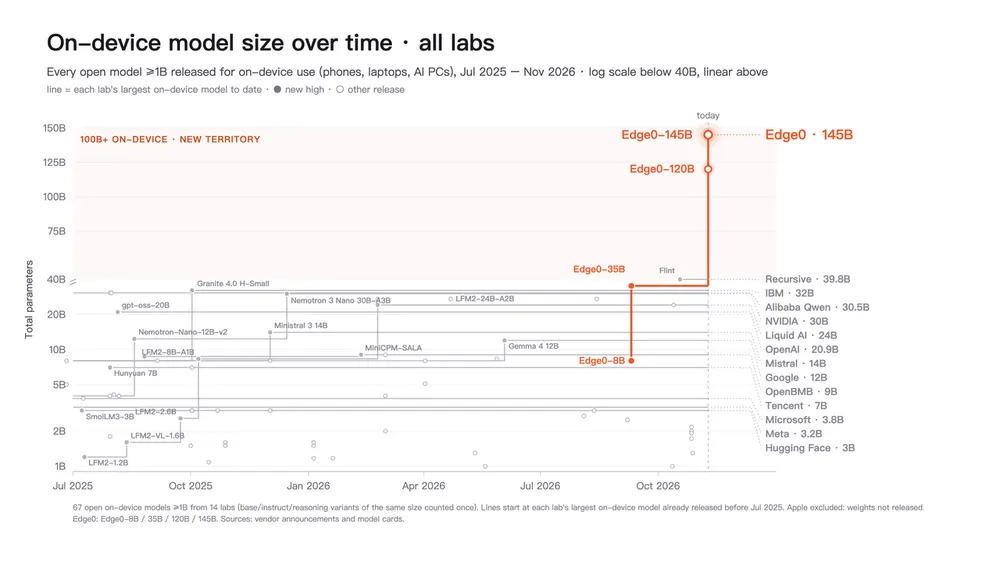
Strip the "world's first open-source on-device frontier model" framing and the artifacts tell a plainer story. The Hugging Face model card lists the base model directly: Qwen3.8-Flash-Next, an 180B-parameter sparse MoE. Edge0 modified the architecture (145B total, 10.12B active per token versus Qwen's ~6B), retrained it "natively at 4 bits," and ships it in two quantizations — Q3_K (40.81 GiB of weights) and NVFP4 (47.79 GiB). The inference engine, edge0-strata, is a fork of Strata, and the repo thanks both upstream teams explicitly. [2] [5]
Edge0-145B architecture (per model card) [unverified — vendor specs]
- 48 layers, 512 experts per layer, 10 routed + 1 shared active per token
- Expert pool: 84.6B params at latent width 1792
- PLE n-gram table: 51.2B params, fp8, memory-mapped from SSD
- MTP draft head: 1.26B (speculative decoding)
- Context: 256K, KV cache int8
That last line — the 51.2B n-gram embedding table living on disk, read on demand — is the actual trick behind the small footprint, and it's inherited from the base model's design. HN users running Qwen3.8-Flash-Next locally confirmed it: roughly 40% of that model's parameters sit on disk and barely dent throughput because only one table row is read per token. [3]
None of this is damning. Fine-tuning a strong open model, tweaking its architecture, and forking a fast engine is how the open ecosystem is supposed to work. What drew fire on HN was the presentation: a dense 19-minute-read marketing page implying novel breakthroughs, over a derivative. [3]
One legal note before the hardware: the GitHub repo is Apache-2.0, but the model weights are not. They ship under the "Edge0 Community Model License 1.0" plus upstream Qwen Community License terms — personal use, research, internal use, and commercial use of outputs are fine, but selling or bundling the model, running a commercial model service, or offering an independent commercial coding/office assistant requires a separate written license. [2] HN's verdict: "open weights with restrictions." [3]
The 29GB Claim vs the Fine Print
This is the part that decides whether you can run it, so it deserves precision.
The blog post claims 29GB peak memory, "runs on a compatible personal laptop, such as a MacBook Pro," ~120W typical power, and "day-one support" for macOS, Windows, and Linux including Apple M-series. [1]
The project's own Hugging Face card and GitHub README report something larger. With "memory residency" enabled — the mode you'd actually use — the same RTX 5090 D 24GB test card held:
Measured residency (vendor tables) [unverified — vendor-measured]
Q3_K  (40.81 GiB weights): 23.14 GiB VRAM + 31.28 GiB host RAM  (~54 GiB)
NVFP4 (47.79 GiB weights): 23.25 GiB VRAM + 38.27 GiB host RAM  (~62 GiB)
Plus: ~51 GB n-gram table streamed from SSD
Total working set: 54–62 GiB across VRAM, RAM, and SSD — not 29GB. HN flagged it directly; one commenter called the headline "just a flat lie," and the blog's own "Under the Hood" section — 40GB expert library, 48GB SSD-resident vocabulary — contradicts its own comparison table. [3] Maybe "29GB" measures some specific subset, but as published, the numbers don't reconcile.
The platform claims have the same problem. The GitHub platforms table says the 145B/120B models require NVIDIA GPUs with CUDA 13 on Linux or Windows — macOS is a dash. The M2 Ultra Metal rows "do not establish macOS release availability," in the repo's own words, and the Edge0 Chat app is Windows-only. [2] [5] The "MacBook Pro" headline currently describes hardware nobody can run this on. There is an encouraging row buried in the speed table, though: the same 5090 D, cgroup-constrained to 16 GiB VRAM + 20 GiB RAM, still managed 44.9 tok/s agent decode on Q3_K. [5] So a 24GB GPU + 32GB RAM desktop can likely run it at usable speed — vendor-measured, so treat it as the optimistic case.
Vendor Benchmarks vs Independent Verification
The claim is "competitive with specific frontier cloud models." The table behind it: Terminal-Bench 2.1 at 86.52 (vs Qwen3.8-Flash-Next 83.3, DeepSeek-V4-Flash-0731 82.7, Claude-Opus-4.6 Max 78.2), DeepSWE 1.1 at 64.6, GPQA-Diamond at 90.4, IFBench at 80.6 — a 72.8 mean across six benchmarks. [1] Three reasons for heavy skepticism:
- Every Edge0 score is an internal evaluation. The blog says so plainly: "Edge0, Qwen, DeepSeek, and Claude results come from Edge0's internal evaluations." The technical report with reproduction instructions is promised, not published. No independent lab — Artificial Analysis, Epoch, SWE-bench maintainers — has published Edge0-145B numbers as of Nov 13. [unverified — absence verified by search]
- The comparison set is curated. No GPT-6, no Gemini 4 — the "frontier" framing rests on one Claude variant, one DeepSeek flash-tier model, and the model's own base. On HLE, Claude-Opus-4.6 still leads 40.0 to 35.4. And beating your own base model's mean by ~1 point (72.8 vs 71.7) is consistent with careful quantization retention — or with benchmark-targeted fine-tuning. HN's most-upvoted skeptic noted that fine-tunes advertising benchmark gains while regressing on general use fill Hugging Face. [3]
- The demos are agent-flattered. The Blender city scenes, PCB-to-Unreal pipeline, and drone program are impressive agent workflows — and the blog's own framing (dozens of iterate-and-check rounds, "hundreds of millions of tokens" if done in the cloud) is exactly the pattern where local models look best, because the marginal token costs nothing. Whether Edge0-145B beats vanilla Qwen3.8-Flash-Next on the same harness is the question the evals don't answer yet.
Hardware Requirements and Cost
Now the part this blog exists for. What you actually need to buy to hit the vendor's claimed speeds — all prices illustrative, Nov 2026 US street:
| Component | Requirement (headline speeds) | Illustrative price (Nov 2026) |
|---|---|---|
| GPU | 24GB NVIDIA (RTX 5090 / 5090 D) | $5,000–7,000 street (MSRP $1,999) [6] |
| GPU (budget floor) | Used RTX 4090 24GB (91.7 tok/s measured) [5] | ~$1,800–2,500 [illustrative] |
| System RAM | 64GB DDR5 (Q3_K residency) | $600–1,100 (was ~$180 a year ago) [7] |
| Storage | Fast NVMe, ~100GB free (weights + 51GB n-gram table) | $60–120 |
| Platform | Desktop CPU, board, 850W+ PSU | $800–1,500 |
| Total (headline build) | ~$6,500–9,500 [illustrative] | |
| Total (floor build) | used 4090 + 32GB RAM | ~$3,300–5,200 [illustrative] |
Two market realities bend this math badly. First, the GPU: the RTX 5090 launched at $1,999 MSRP, but the street price tracker now shows roughly $5,000–7,000 new, a ~370% premium driven by AI-datacenter demand. [6] Second, the RAM: 64GB DDR5 kits that cost under $200 in 2025 now run $600–1,100+, with analysts projecting shortage conditions into 2028. [7] You are buying the parts the cloud providers bid up.
The laptop story is currently vapor: no macOS runtime shipped. The only laptop-class hardware in the vendor's speed table is the RTX Spark N1X 60 GiB at 36.7–46 tok/s agent decode [5] — real numbers, but a machine class priced like the desktop build. This is the same tension as in "Voltage Glitching Unlocked an A100 in a Mining Card: The DIY AI Compute Question (2026)": the cheapest honest path to local AI compute is hunting used silicon, not chasing headline builds. A used 4090 — the same pricing logic as "ACEMAGIC Starship M2A: i9-12900H + RTX 3070 16GB Mini PC at ~1.04M KRW (2026)" — is the rational entry point, not a new 5090.
Power is the one cost that favors local. The vendor claims ~120W typical on its reference laptop [1] [unverified]; a desktop 5090 under sustained decode realistically draws 200–350W [illustrative]. At $0.15/kWh: 8 hours/day ≈ $5–13/month; 24/7 ≈ $22–39/month. Electricity is noise next to the capex.
The Capex vs API Math
The honest comparison is the vendor's own numbers turned against it. Edge0's demos cite cloud equivalents like "more than $150 in cloud token charges" for one Blender scene and "hundreds of millions of tokens" for one game-city completion. [1] [unverified — vendor arithmetic] That's the right workload to model, because heavy agentic coding is where API bills actually hurt. Illustrative tiers: a $20/month chat-plan user, and a heavy agentic developer at $100–500/month. [illustrative]| Scenario | Upfront | Ongoing | Break-even vs $150/mo API [illustrative] | | --- | --- | --- | --- | | Headline build (5090 + 64GB) | ~$8,000 | ~$13–39/mo power | ~53–60 months | | Floor build (used 4090 + 32GB) | ~$4,200 | ~$8–20/mo power | ~28–31 months | | Used 4090 + 64GB (comfortable) | ~$5,000 | ~$8–20/mo power | ~33–36 months | | Mac 64GB route | ~$3,500+ | minimal | N/A — no runtime shipped |
Read that table honestly: the math only closes for heavy agentic users, on used hardware, over 2+ years — and it assumes the model stays good enough that you don't want next year's frontier model, which history says you will. For the $20/month user, buying hardware is a worse deal than a subscription, forever. The vendor's own demos — hundred-dollar cloud bills for single creative completions — describe an enterprise workload, not a person's monthly spend.
Who This Actually Makes Sense For
Not "everyone with a laptop," whatever the headline says. The credible use cases today: a heavy agentic-coding developer already spending $150+/month who can source a used 24GB card, values data locality, and treats the rig as a multi-year platform; and teams whose work (PCB designs, unreleased code, client data) legally can't ride through a cloud API. Everyone else: wait for the independent benchmarks, the macOS/Metal runtime, and — more importantly — the GGUF conversions from llama.cpp's ecosystem, which historically slash the hardware requirements within weeks of a release like this. [3]## Wrap-up
- The engineering is real — but Edge0-145B is a Qwen3.8-Flash-Next derivative with vendor-only benchmarks, no independent verification, and a "29GB" memory claim its own measured residency tables contradict by 2x.
- The honest hardware floor is a 24GB GPU + 32–64GB RAM + fast NVMe: ~$3,300–5,200 used, ~$6,500–9,500 new [illustrative] — in a market where AI demand has made GPUs and RAM historically expensive. The "runs on a MacBook" claim is unsupported: no macOS runtime shipped.
- Capex-vs-API math only closes for heavy agentic users on used hardware over 2+ years [illustrative]. For everyone else: wait for independent evals and community GGUF conversions before spending a dollar.
Sources
- Edge0 blog — Introducing Edge0-145B: Frontier AI Capabilities on Your Own Computer (Nov 12, 2026)
- GitHub — Edge0-AI/Edge0 (README, platforms table, license)
- Hacker News — Edge0-145B discussion (236 points, Nov 2026)
- Hugging Face — Edge0-145B-NVFP4 model card (residency and speed tables, license)
- arXiv — The Other Half of the Memory Wall: Serving 35B MoEs from SSD with Trained Routing Prediction (Edge0 technical report, prior release)
- Tom's Hardware — GPU price tracking (RTX 5090 street price, Nov 2026)
- Tom's Hardware — Memory prices climb 500% in 12 months (DDR5, Nov 2026)
Related Posts
- CES 2027 Preview: AMD Zen 6 vs Intel Nova Lake — and the DDR5-8000 Tax Nobody Is Pricing In2026. 11. 25
- November Memory Price Reality Check: Consumer and Enterprise Are Now on Different Paths2026. 11. 24
- NVIDIA's Q3 Numbers Explain Why GeForce Won't Get Cheaper: $390 Billion in Supply Commitments2026. 11. 24